


You Need a Car. Not Six Months From Now.
You need transportation. Maybe your current car is barely running. Maybe you need something reliable to get to work. Maybe you're borrowing rides, paying for Uber, rearranging childcare, or watching repair bills pile up on a vehicle that's already on borrowed time.
And somewhere in the back of your mind is the question you don't really want answered: "What is my credit going to do to this car loan?"
Because getting approved is only half the fear. The other half is sitting across from someone at a dealership and hearing "Good news. We got you approved." — only to discover that the "good news" comes with an APR approaching 20% or more.
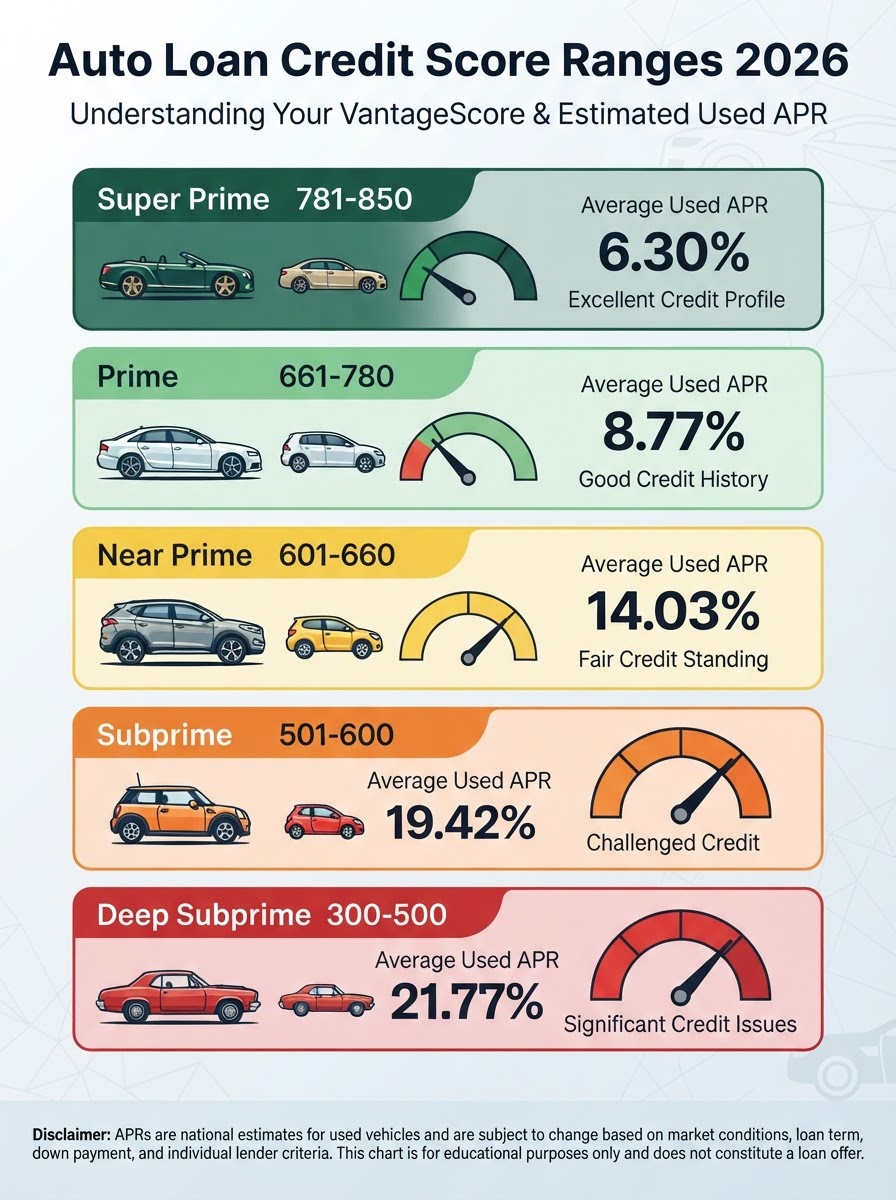
That fear is not imaginary. Experian's Q1 2026 data shows average used-car APRs of approximately:
- 6.30% for super-prime borrowers
- 8.77% for prime borrowers
- 14.03% for near-prime borrowers
- 19.42% for subprime borrowers
- 21.77% for deep-subprime borrowers
Those are averages, not quotes or guarantees, but the gap illustrates why your financing deserves attention before you fall in love with a car. [2]
Here's the part most buyers aren't told clearly enough: There is no universal minimum credit score required to get a car loan. Banks, credit unions, finance companies, online lenders, and dealerships can use different underwriting standards and even different versions of your credit score. [2]
So if you're searching "how to get approved for a car loan with bad credit," don't make your entire strategy: "I hope the dealership can get me financed." There's a better approach. Know what's on your credit. Know what the numbers could mean. Know what you can legitimately address. Know what you're willing to pay. And walk into the dealership with a financing comparison already in your pocket. Here are the five steps.

1. Know Your 2026 Auto Loan Credit Score Range Before Anyone Pulls Your Credit
Let's start with the question nearly every buyer asks: What credit score do I need for a car loan in 2026?
There isn't one universal cutoff. Instead, lenders tend to price borrowers according to risk. Experian's Q1 2026 State of the Automotive Finance Market data uses these VantageScore 4.0 ranges: [2]
| Credit Score Range | Credit Tier | Avg. New-Car APR | Avg. Used-Car APR |
|---|---|---|---|
| 781–850 | Super Prime | 4.55% | 6.30% |
| 661–780 | Prime | 6.23% | 8.77% |
| 601–660 | Near Prime | 9.67% | 14.03% |
| 501–600 | Subprime | 13.44% | 19.42% |
| 300–500 | Deep Subprime | 16.01% | 21.77% |
These numbers are market averages, not the rate you are guaranteed to receive. Your actual offer can depend on your credit history, income, debt, loan amount, down payment, vehicle, loan term, lender, and other underwriting factors. The CFPB confirms that credit is an important factor in auto-loan pricing, but it is not the only one. [3]
Why this matters before you shop
Imagine financing $30,000 for 60 months. At a hypothetical 8.77% APR, the principal-and-interest payment would be roughly $620 per month. At 19.42%, it would be roughly $786 per month. That's about $166 more every month in this illustration. And approximately $10,000 more across five years. Same $30,000 financed. Very different borrowing cost.
That's why this article isn't just about getting approved. It's about becoming a more prepared borrower before you negotiate the deal.
Car Loan Rate & APR Estimator
Enter your estimated credit score to see the Q1 2026 average used-car APR for that score tier.
Educational estimate only. Average APR data is based on Experian Q1 2026 VantageScore 4.0 ranges. Your lender may use a different credit score and may offer a higher or lower APR. This is not a loan offer, approval prediction, or rate guarantee.
Look at the total interest, not just the payment. That number is the reason preparing your credit and shopping financing before the dealership can matter.
2. Pull Your Credit Reports Before the Dealer Does
If you're asking "How do I fix my credit to buy a car?" — start by replacing the word fix with verify. Because before you start moving money, sending disputes, opening accounts, closing cards, or taking advice from somebody on social media, you need to know: What is actually being reported about you?
The CFPB specifically recommends checking your credit reports before applying for an auto loan and disputing errors or inaccuracies that could affect your credit. [4] Look for information such as:
- an account that does not belong to you,
- a payment reported late when your records show it was on time,
- an incorrect balance,
- an incorrect account status,
- duplicate account reporting,
- a closed account incorrectly listed as open,
- identity-theft-related accounts,
- inaccurate dates,
- inaccurate payment history,
- or information that appears incomplete.
Under the Fair Credit Reporting Act, you have the right to dispute information that you believe is inaccurate or incomplete. Credit reporting companies generally must investigate qualifying disputes. [5]
That is why your goal should not be: "How many negative items can I challenge?" Your goal should be: "Can I document why this specific information is inaccurate or incomplete?" That is a much stronger consumer position.
Dealership Defense Credit Checklist
Check each item only after you have actually reviewed it.
Build an audit trail
If you identify a legitimate problem, keep records. Save: the report showing the disputed information, statements or receipts supporting your position, confirmation numbers, copies of dispute correspondence, dates submitted, responses received, and the updated report if something changes.
Don't turn a dispute into a guessing game. Turn it into a documented consumer-rights process. That is the kind of preparation taught inside The Weekend Credit Readiness System. Not magic letters. Not "secret loopholes." Not a promise that accurate negative information disappears. A process.
3. Look at Credit Card Utilization Before You Apply
Credit report accuracy isn't the only thing worth reviewing. If you're carrying revolving credit-card balances, look at your utilization. A simple version is: Reported balance ÷ credit limit × 100 = utilization
For example, if a card has a $1,000 limit and a $850 reported balance, then its utilization is 85%. If the reported balance were $250 instead, utilization would be 25%. Credit utilization can influence credit-scoring calculations.
But here's where borrowers can get themselves into trouble: they hear that utilization matters and immediately drain all of their cash trying to pay every card down before buying a vehicle. That may not always make sense. You may also need money for: a down payment, registration, sales taxes, insurance, repairs, emergency savings, or expenses that come with replacing your transportation.
What you can do is review revolving debt, understand utilization, and decide whether reducing balances fits your larger car-buying budget.
4. Get Financing Options Before You Get Emotionally Attached to the Car
This may be the most important move in the entire article. Do not assume the dealership is your only source of financing.
The CFPB specifically says you are not required to finance through a dealer and recommends comparing banks, credit unions, and other lenders before shopping for the vehicle. A preapproval can also give you something concrete to compare with dealership financing. [7]
Why does this matter? Because once you sit in a car you love, once you've driven it, once you've pictured it in your driveway, once you've mentally decided "This is the one" — you are negotiating from a different emotional position. The financing can begin to feel like an annoying detail standing between you and the keys.
That is precisely when people start asking the wrong question: "Can you get my payment under $600?" Instead, you should be asking:
- What is the vehicle price?
- What amount am I financing?
- What is the APR?
- What is the term?
- What is the total of payments?
- What add-ons are included?
- What is my down payment?
- Is there a prepayment penalty?
- How does this offer compare with my outside financing?
Monthly payment is not the whole deal
A lender or dealer may be able to lower a monthly payment by stretching the loan over more months. That doesn't necessarily make the vehicle cheaper. It can mean you remain in debt longer and potentially pay more interest. The CFPB also explains that dealer-arranged financing may include compensation or markup above a lender's underlying "buy rate," and that dealership financing terms can be negotiable. [3]
So don't walk in asking: "Can you get me approved?" Walk in knowing: "I already have a financing benchmark. Show me whether you can beat it." That's a completely different conversation.
5. Use the Time You Have — Even If the Car Purchase Is Coming Fast
Maybe you're thinking: "This is useful, but I don't have six months. I need a car now." Fair. You should not be promised a particular credit-score improvement in 7 days, 30 days, 90 days, or any other timeframe. But the amount of time you have does change what preparation makes sense. Use this tool.
Your Auto Loan Readiness Timeline
How soon do you expect to shop for your vehicle?
The CFPB says that when consumers shop for auto financing, multiple auto-loan inquiries made within roughly 14 to 45 days will generally be treated as a single inquiry for scoring purposes, depending on the scoring model. [4] It recommends comparing lenders before shopping for the vehicle. That means shopping around is not something you should automatically be afraid of. Shopping blindly is the bigger problem.
"But What If My Credit Is Really Bad?"
Then this matters even more. Not because there's a secret way to erase your history. There isn't. And not because a PDF can guarantee that a lender says yes. It can't.
It matters because the more expensive borrowing becomes, the more costly it can be to enter the financing process without understanding what you're signing. Think again about the Q1 2026 averages. A used-car borrower in Experian's prime category averaged 8.77% APR. A subprime borrower averaged 19.42%. A deep-subprime borrower averaged 21.77%. [2]
That doesn't mean you're destined for one of those numbers. It means that when your credit profile is weaker, the financing deserves more attention, not less. You may urgently need the vehicle. That does not mean you have to arrive completely unprepared.
Three Things to Do Before You Step Onto the Lot
If you're overwhelmed by everything in this article, remember these three.
Verify before you dispute.
Look for inaccurate or incomplete information. Document it. Dispute legitimate errors. Don't dispute accurate information simply because you want it gone.
Review your balances before somebody reviews them for you.
Know your revolving balances. Know your debt obligations. Know how much cash you can realistically use without leaving yourself financially exposed.
Know your financing alternatives.
A dealer should not be the first person to tell you what borrowing money might cost. Compare lenders. Know your budget. Bring a financing benchmark. Then evaluate the dealer's offer against something real.
The Expensive Mistake Isn't Always Getting Denied
Sometimes getting denied is what buyers fear most. But consider another possibility. You get approved immediately. You're relieved. The payment sounds barely manageable. You sign.
Then later you realize you never compared the APR. You never checked your reports. You never asked about other lender offers. You never separated the vehicle price from financing. You never calculated the total interest. You were so focused on hearing "approved" that you stopped asking whether the deal actually made sense.
That is exactly the situation you want to avoid. You don't need to become a credit expert. You need a process.
Before You Hand a Dealer Your Social Security Number, Give Yourself One Weekend
The Weekend Credit Readiness System is an educational PDF designed to help you turn scattered credit information into an organized pre-application review. It does not promise score increases, removal of accurate information, or loan approvals.
You're probably going to spend thousands of dollars on the vehicle. The Weekend Credit Readiness System costs $17. Not because $17 magically repairs your credit. You're buying organization. A process. A way to sit down this weekend and stop saying "I really need to figure out my credit" — and actually start figuring it out.
Instant digital access • One-time payment • Educational self-help system
Frequently Asked Questions
How do I get approved for a car loan with bad credit?
There is no universal credit-score requirement for an auto loan. Different lenders use different underwriting criteria and may evaluate your credit history, income, existing debts, loan amount, vehicle, down payment, and other factors. Preparation can include reviewing your credit reports for inaccuracies, evaluating your budget and balances, and comparing financing from multiple lenders before visiting a dealership. [2]
What credit score do I need to buy a car in 2026?
There is no single minimum score that applies to every auto lender. Experian reports 2026 borrower tiers ranging from deep subprime at 300–500 through super prime at 781–850, but lenders can establish their own requirements and use different credit-scoring models. [2]
What are average auto loan rates by credit score in 2026?
Experian's Q1 2026 averages for used vehicles were 6.30% for super prime, 8.77% for prime, 14.03% for near prime, 19.42% for subprime, and 21.77% for deep subprime borrowers. Actual rates vary by lender and borrower. [2]
Can I get a car loan with a 500 credit score?
Some lenders serve borrowers with scores around 500 or below, but there is no universal guarantee of approval. Experian classifies VantageScores from 300–500 as deep subprime in its Q1 2026 auto-finance data. Your lender may use a different scoring model and other underwriting criteria. [2]
How can I lower my car loan interest rate with bad credit?
No single action guarantees a lower rate. You can improve your negotiating position by reviewing your credit reports for legitimate inaccuracies, considering your debt and down payment, comparing multiple lenders, and obtaining financing quotes before relying on dealer-arranged financing. The CFPB says dealer financing is negotiable and recommends shopping around. [7]
Should I get preapproved before going to a dealership?
It can be useful. The CFPB recommends seeking preapproval or financing quotes from banks, credit unions, or other lenders before visiting a dealer. An outside offer gives you a financing benchmark that you can compare with the dealer's terms. [7]
Will shopping for a car loan hurt my credit?
Auto-loan rate shopping generally has little to no impact when handled within a concentrated shopping period. The CFPB says multiple auto-loan inquiries made within approximately 14 to 45 days are generally treated as a single inquiry, depending on the scoring model. [4]
Can I remove late payments before applying for an auto loan?
If a late payment is inaccurate or incomplete, you have the right under federal law to dispute it. If the information is accurate and current, it generally cannot legally be removed merely because it negatively affects your credit. [6]
Can a credit repair company guarantee a higher score?
Claims promising guaranteed score increases or removal of accurate negative information should raise concerns. The FTC has repeatedly taken action against credit-repair businesses making misleading claims and charging prohibited upfront fees for covered services. [1]
Editorial and Consumer Disclosure
This content is provided for general educational purposes and does not constitute legal, financial, credit, lending, or tax advice. Everything AI, LLC is not representing that purchasing an educational product will improve a consumer's credit score, remove accurate information, qualify the consumer for financing, reduce an interest rate, or result in approval by any lender.
Consumers can review and dispute information they believe is inaccurate or incomplete themselves without purchasing a product. The FTC explains that consumers can legally perform credit-report dispute activities themselves at little or no cost and that accurate current negative information generally cannot be removed merely because it is unfavorable. [6]
Interest rates and credit-score tiers shown in this article are educational market averages and illustrations, not individual loan offers. Lenders may use different credit-scoring models, underwriting criteria, and pricing.
CROA & FTC Compliance: In compliance with the Credit Repair Organizations Act and FTC regulations, we do not charge upfront fees for credit repair performance services, nor do we act as an intermediary to alter your credit file on your behalf.
Trademark & Regulatory Attribution: Experian, VantageScore, FICO, Equifax, TransUnion, CFPB, and FTC are registered trademarks of their respective entities. Everything AI, LLC is not affiliated with, endorsed by, or sponsored by these agencies. Copyright © 2026 Everything AI, LLC. All rights reserved.
Sources & References
- Credit Repair Organizations Act — Federal Trade Commission. Statutory overview of CROA provisions governing credit-repair organizations, including prohibitions on advance fees and misleading claims.
- What Is a Good Credit Score for an Auto Loan? — Experian. Q1 2026 State of the Automotive Finance Market data showing average APRs by VantageScore 4.0 credit tier for new and used vehicle loans.
- How does a lender decide what interest rate to offer me on an auto loan? — Consumer Financial Protection Bureau. Explanation of auto-loan pricing factors including credit history, dealer markup, and the buy rate.
- How will shopping for an auto loan affect my credit? — Consumer Financial Protection Bureau. Guidance on rate-shopping windows (14–45 days) and credit report review before applying for auto financing.
- What if I disagree with the results of my credit report dispute? — Consumer Financial Protection Bureau. Consumer rights under the FCRA to dispute inaccurate or incomplete credit report information.
- Credit Repair: Fixing Mistakes on Your Credit Report — FTC Consumer Advice. FTC guidance confirming that accurate, current negative information generally cannot be removed and that consumers can dispute errors themselves at little or no cost.
- Am I required to get my auto loan through a dealership? — Consumer Financial Protection Bureau. Guidance confirming consumers are not required to finance through a dealer and recommending preapproval comparisons.