

Executive Summary: The Personal-to-Commercial Credit Bridge
Tier-1 commercial lenders (such as Chase, Amex, Bank of America, and Citi) rarely approve high-limit business credit on the merits of a new LLC alone. Instead, they perform a Personal Guarantee (PG) audit.
These banks use automated underwriting algorithms to evaluate your personal credit file. They are looking for specific indicators of financial stability before extending commercial lines. If your personal profile has reporting inaccuracies or unresolved issues, your business applications may face automated rejections.
Tier-1 Business Credit Eligibility Calculator
Audit your personal credit profile against commercial underwriting algorithms to determine your $50K+ funding capacity.
1. Personal FICO 8 / Bankcard Score
Tier-1 business credit card issuers perform personal guarantee audits.
1. Personal Profile Architecture & The Tier-1 Benchmark Score
When applying for business capital, the score you see on free consumer apps is rarely the one lenders use. Tier-1 lenders typically pull FICO 8 or FICO 9 Bankcard scores, which weigh revolving credit behavior more heavily than standard models.
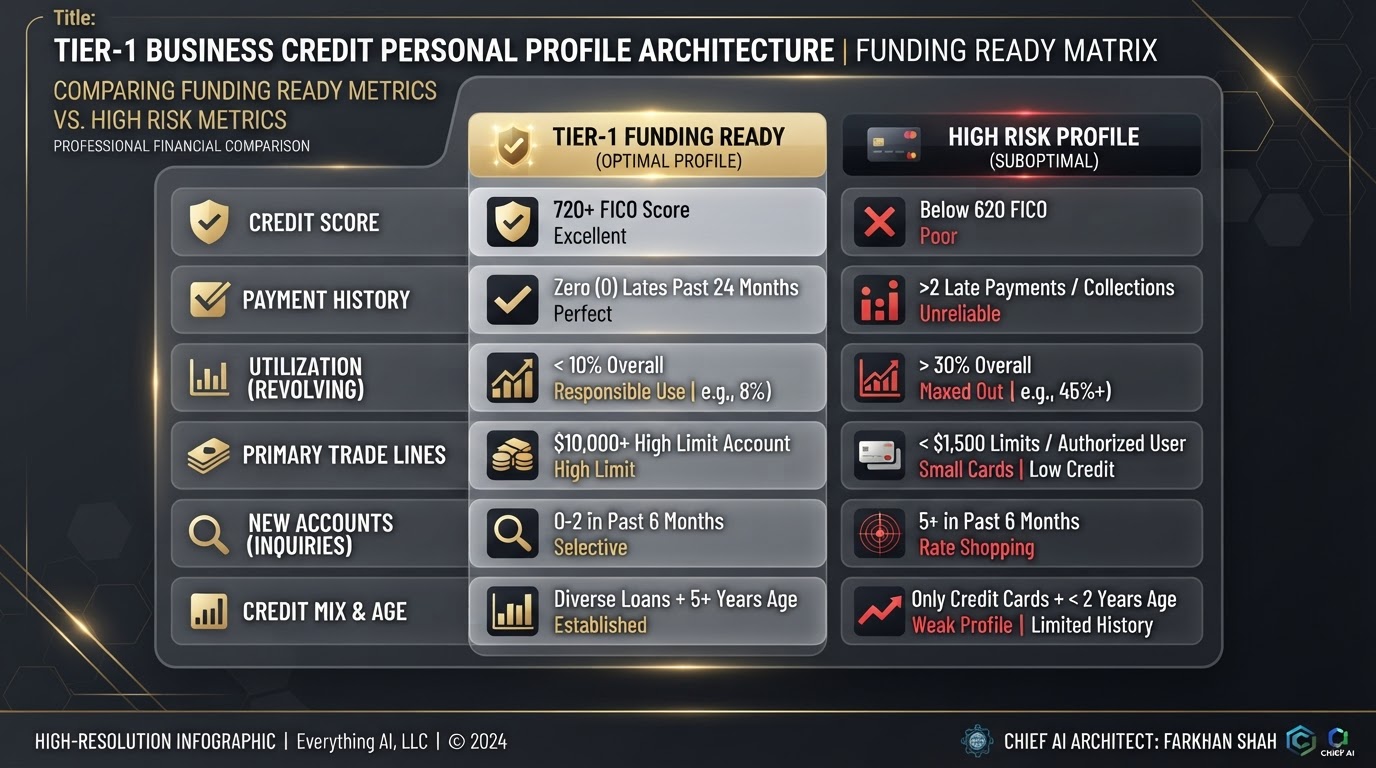
To pass the automated underwriting gates for high-limit funding, your profile must meet specific baseline requirements:
- Zero Late Payments (24-Month Minimum): A single 30-day late payment within the last two years may trigger a denial for premium business cards.
- The 720+ Baseline: While some approvals happen at 680, a 720+ FICO score is a common benchmark lenders use to evaluate eligibility for competitive interest rates and higher limits.
- Account Age: Your oldest revolving account should ideally be greater than 5 years old, demonstrating long-term credit management.
2. Credit Utilization Optimization (The <10% Total / <5% Individual Card Rule)
High credit utilization is a common factor in business funding denials. Lenders may view high personal balances as an indicator that business credit could be used to cover personal debt.
Automated systems run "Risk Adjustment Algorithms" that scrutinize your balance-to-limit ratios. To optimize for approval:
- Total Utilization: Keep your aggregate personal credit utilization strictly under 10%.
- Individual Card Utilization: No single personal card should exceed 5% to 9% of its limit. Maxing out a $500 card, even if your total utilization is low, can trigger a high-risk flag.
3. Hard Inquiry Cleansing & Bureau Distribution Strategies
When seeking business funding, recent hard inquiries are heavily scrutinized. More than 3 to 4 inquiries within a 6-month period signals "Credit-Seeking Behavior" or potential financial distress to an algorithm.
Before applying, you may audit your inquiries for Permissible Purpose under FCRA § 604. If an inquiry lacks proper authorization or resulted from rate-shopping without a clear permissible purpose, you may exercise your FCRA rights to dispute it. Furthermore, strategic applicants route their applications across different bureaus (Equifax, Experian, TransUnion) to minimize inquiry stacking on a single report.
Auditing hard inquiries before applying for business capital?
Use our free Inquiry Permissible Purpose Checklist on the creditrepair.everythingainow.com resource portal.
4. Primary Personal Limit Scaling (The Benchmark Multiplier Effect)
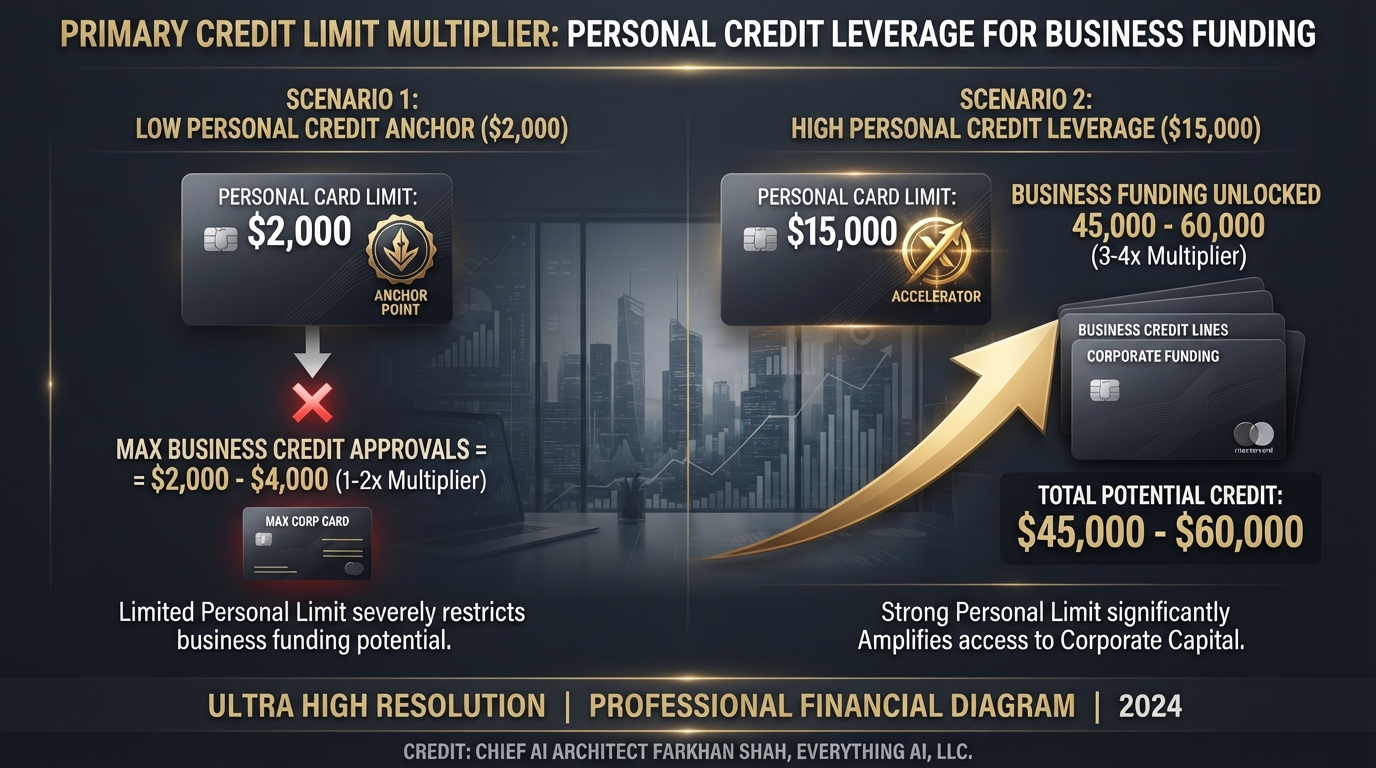
Business lenders rarely extend commercial lines that vastly exceed your proven personal capacity. They use your highest primary personal card limit as an anchor ceiling.
This is known as the Benchmark Multiplier Effect. If your highest personal limit is $2,000, lenders may approve you for similar low limits on the business side. However, if you scale a personal card to a $15,000 limit, lenders may be more comfortable extending higher amounts in business credit. Consider requesting strategic credit limit increases on your personal cards before applying for commercial funding.
5. Commercial Separation & Non-Reporting Business Debt
The ultimate goal of business funding is to obtain capital that does not report to your personal credit profile, protecting your personal utilization from business expenses.
You must understand the difference between No-PG (No Personal Guarantee) and PG (Personal Guarantee) strategies, and more importantly, which issuers report to consumer bureaus:
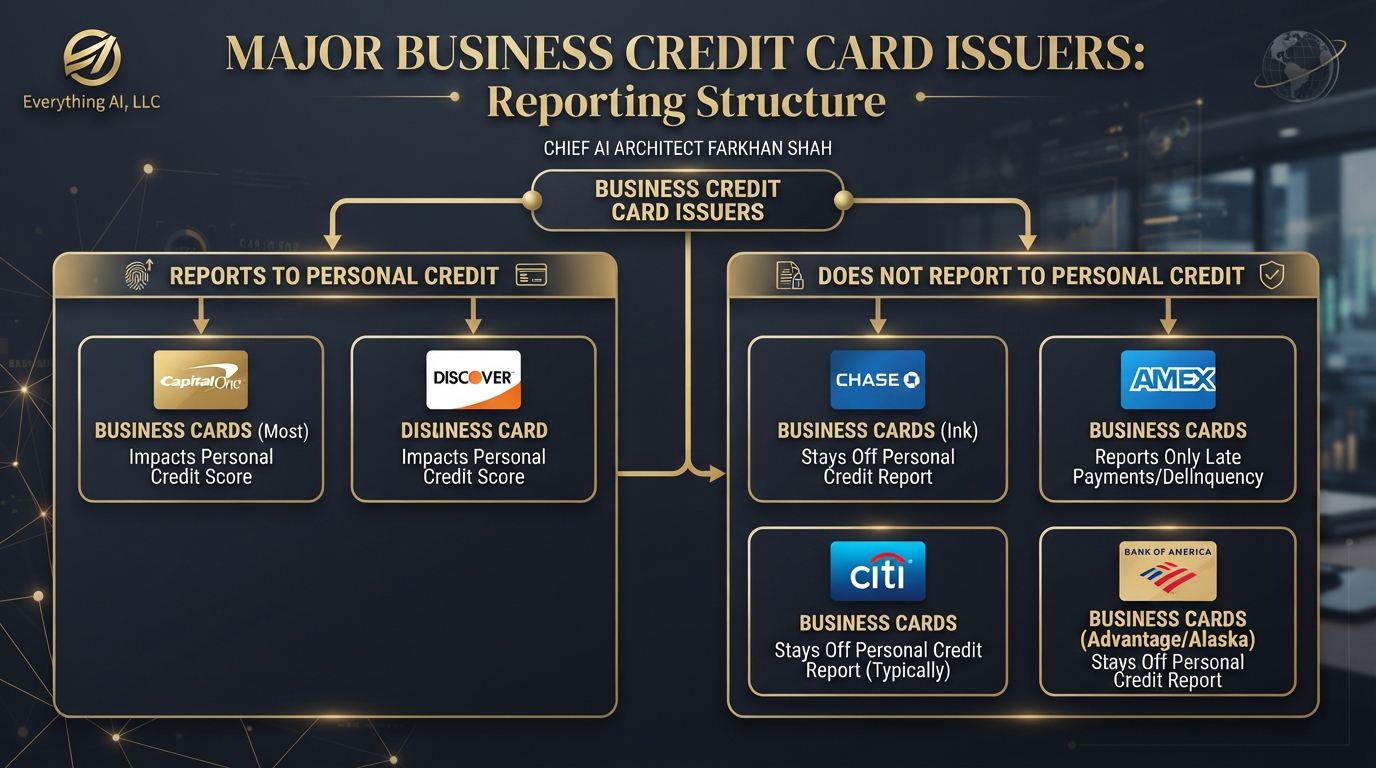
- Non-Reporting Issuers: Chase Ink, Amex Business, and Citi Business typically do NOT report monthly balances to personal credit bureaus (unless you default).
- Reporting Issuers: Capital One Spark and Discover Business often DO report business activity to your personal credit, which may negatively affect your personal utilization if you carry a high business balance.
Tier-1 Commercial Credit Card Comparison Matrix
Compare Personal Guarantee (PG) requirements, bureau pulls, 5/24 rules, and credit reporting policies across Chase, Amex, Citi, BofA, and Capital One.
JPMorgan Chase
Flagship Offer: Chase Ink Business Unlimited®
Requires hard pull & PG for standard LLCs. Hard pull acts on personal file, but ongoing debt stays off personal report.
✅ Safe: Carrying a business balance here does NOT impact your personal debt-to-income or utilization ratios.
🔥 12 Months 0% Intro APR Available
Subject to 5/24 rule! Must apply BEFORE reaching 5 new personal accounts in 24 months. Does not ADD to 5/24 count once approved.
- Strictly enforced 5/24 rule (cannot have opened 5+ personal cards in last 24 months)
- Does NOT report monthly balances to personal credit bureaus
- Soft maximum $100K combined Chase credit limit across personal & business without manual financial review
- Re-allocation of business limits allowed between Ink cards
Full Commercial Issuer Comparison Table
Scroll horizontally on mobile →| Issuer | PG Details | Reports to Personal? | Primary Bureau | Min FICO | 0% APR | Best Used For |
|---|---|---|---|---|---|---|
| JPMorgan Chase Chase Ink Business Unlimited® | Personal Guarantee (PG) | NO | Experian (Primary) + Equifax (State dependent) | 720+ | 12 Mo. | 0% APR working capital & high initial limit anchor |
| American Express Amex Blue Business Plus® | Personal Guarantee (PG) | NO | Experian (Soft pull for existing customers) | 700+ | 12 Mo. | Fast scaling with soft pulls for existing Amex members & 0% APR on Blue Business Plus |
| Citibank CitiBusiness® / AAdvantage® Platinum Select® | Personal Guarantee (PG) | NO | Experian or Equifax (Depending on State) | 720+ | None | Diversifying away from Chase/Amex inquiry exposure & travel/rewards stacking |
| Bank of America Bank of America® Business Advantage Customized Cash | Personal Guarantee (PG) | NO | Experian or TransUnion | 700+ | 9 Mo. | Businesses with liquid cash reserves seeking high 0% APR lines |
| Capital One (WARNING) Capital One Spark Cash Plus® (Pay-in-Full) | Personal Guarantee (PG) | YES | Triple Bureau Pull (Experian + Equifax + TransUnion simultaneously!) | 720+ | None | High-spend business owners who can pay in full monthly (Spark Cash Plus only) |
Commercial PG Rules & Issuer Underwriting Cheat Sheet
Personal Guarantee (PG) compliance, bureau pull mapping, 5/24 status rules, and commercial reporting matrix.
PG holds your personal credit responsible in default, but non-reporting issuers keep your monthly business balances off your personal report.
Commercial underwriters anchor your business card limits against your highest primary personal card limit (e.g. $15k personal = $45k business).
Chase, Amex, Citi, & BofA do NOT report monthly debt to personal credit. Capital One Spark revolving cards DO report to personal credit.
| Issuer | PG & Reporting Status | Bureau Pulled | 5/24 & Application Rules | Min FICO & Limit Anchor |
|---|---|---|---|---|
| JPMorgan Chase | PG Required • DOES NOT Report Balances to Personal | Experian (Primary) + Equifax | Strict 5/24 Rule! Must apply before reaching 5 personal cards in 24 months. | 720+ FICO • 2.5x – 4x Highest Personal Limit |
| American Express | PG Required • Soft Pull for Existing Members • DOES NOT Report | Experian (Soft pull if existing customer) | Ignores 5/24 rule. Max 5 revolving credit cards limit. 3x CLI after 61 days. | 700+ FICO • 3x – 5x Highest Personal Limit |
| Citibank | PG Required • DOES NOT Report Balances to Personal | Experian or Equifax (State dep.) | 1/8 & 2/65 Rule (Max 1 app per 8 days, 2 per 65 days). Requires clean inquiry profile. | 720+ FICO • 2x – 3.5x Highest Personal Limit |
| Bank of America | PG Required • DOES NOT Report Balances to Personal | Experian or TransUnion | Existing BofA Business Checking deposits ($10k+ liquid) significantly boost limits. | 700+ FICO • 2x – 4x Highest Personal Limit |
| Capital One ⚠️ | ⚠️ PG Required • REPORTS Monthly Debt to Personal! | Triple Bureau Pull (EX + EQ + TU) | Spark Miles & Spark Cash Select report balances to personal credit & increment 5/24! | 720+ FICO • 1.5x – 3x Highest Personal Limit |
Educational Commercial Credit Reference Sheet • creditrepair.everythingainow.com
Compliance FAQ & Legal Lookup Engine
Search specific statutes, commercial PG rules, Metro 2 codes, or e-OSCAR rejection codes below.
Compliance FAQ & Legal Lookup Engine
Instant real-time search across FCRA statutes, Metro 2 fields, e-OSCAR rules, and regulatory escalation guidelines.
e-OSCAR uses Optical Character Recognition (OCR) scanners to parse dispute letters into 2-digit Automated Dispute Verification (ADV/ACDV) codes. Generic internet templates containing phrases like 'Validate this debt' or 'Not mine' trigger e-OSCAR Frivolous Dispute Rejection Codes under FCRA § 612 (15 U.S.C. § 1681i(a)(3)), allowing credit bureaus to dismiss the dispute without contacting the bank.
6. Business Entity & Commercial Profile Alignment
Even with a strong personal credit profile, an application may be denied if the business entity data is inconsistent. Automated underwriting systems cross-reference your application with commercial databases.
To prevent automated identity rejections, ensure strict alignment across:
- Secretary of State Registration: Your business name and address must perfectly match your state filings.
- EIN & DUNS Number: Ensure your Employer Identification Number and Data Universal Numbering System (DUNS) profile reflect the exact same business details.
- LexisNexis & Paydex: Lenders pull from LexisNexis for identity verification and Dun & Bradstreet (Paydex) for commercial credit history. Inconsistencies here trigger immediate fraud alerts.
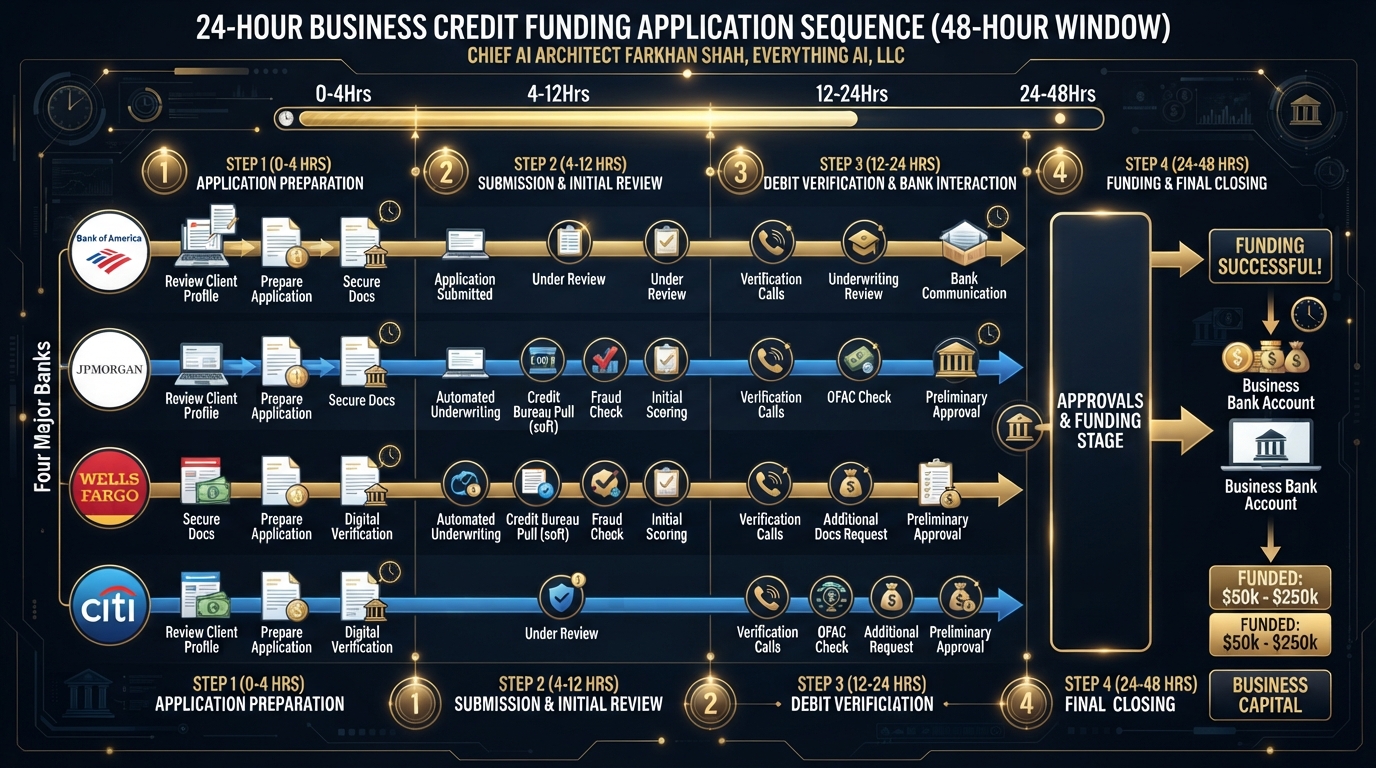
7. Strategic Application Batching (The 24-Hour Funding Sequence)
If you need significant funding, applying for one card at a time over several months may be inefficient and can expose you to inquiry cross-contamination (where Lender B sees the inquiry from Lender A and may deny you).
The solution is Strategic Application Batching. By preparing your profile and applying for 3 to 5 tier-1 business lines within a tight 24-hour window, you may secure multiple approvals before the new inquiries populate across all bureau networks. This requires knowing exactly which bureau each lender pulls in your specific state.
Legal Disclosures & Operational Compliance
Educational Content Notice: The articles, software tools, digital templates, and blueprints provided on creditrepair.everythingainow.com are published by Everything AI LLC strictly for educational, informational, and self-help purposes. Everything AI LLC, Farkhan Shah, and its affiliates are not a law firm, credit repair organization (CRO) as defined under local or federal statutes, or financial advisory firm, and do not provide formal legal representation, credit repair services, or certified financial planning.
No Guarantee of Results: Individual consumer credit profiles, history, and statutory responses vary. Federal laws such as the Fair Credit Reporting Act (FCRA) (15 U.S.C. § 1681 et seq.) grant consumers the right to dispute inaccurate, incomplete, or unverifiable data directly with Consumer Reporting Agencies (Equifax, Experian, TransUnion). However, no software, template, or guide can guarantee the removal of 100% accurate, timely, and fully verifiable negative tradelines or bankruptcy records prior to their statutory expiration dates.
Credit Repair Organizations Act (CROA) & FTC Compliance: In compliance with FTC regulations and federal consumer protection statutes, we do not charge upfront fees for credit repair performance services, nor do we act as an intermediary to alter your credit file on your behalf. All tools and templates provided are designed to empower you to execute your own lawful, factual disputes directly.
Trademark & Regulatory Attribution: Equifax, Experian, TransUnion, e-OSCAR, CFPB, and FTC are registered trademarks of their respective corporate entities. Everything AI LLC is an independent software and educational publisher and is not officially affiliated with, endorsed by, or sponsored by these agencies. Copyright © 2026 Everything AI LLC. All rights reserved.