

The minimum credit score to buy a house in 2026 depends on your loan type: FHA loans require at least 580 for 3.5% down (500 with 10% down), Conventional loans typically require 620, VA loans have no official minimum (lenders often want 580+), and USDA loans generally require 640. However, meeting the minimum score does not guarantee approval — lenders also evaluate your debt-to-income ratio, employment history, and down payment funds.
The Fear of the Denial Letter
You found the house. You ran the numbers. You can afford the monthly payment. But there's one question standing between you and the front door: "What credit score do I need to buy a house?"
If you've been avoiding your credit report because the numbers feel confusing or intimidating, you're not alone. Most first-time homebuyers delay applying not because they can't afford the home, but because they're afraid of being told "no" by a lender.
Here's the good news: the 2026 mortgage landscape is more flexible than most people realize. The minimum credit score to buy a house is not a single universal number — it depends entirely on which type of loan you're applying for. And for many loan programs, the threshold is lower than you might expect.
In this guide, we'll break down the exact credit score requirements for every major loan type in plain English, explain the difference between being eligible and being financially ready, and walk through three practical steps you can review before you ever speak to a loan officer.
1. 2026 Mortgage Credit Score Thresholds: FHA vs. Conventional vs. VA vs. USDA
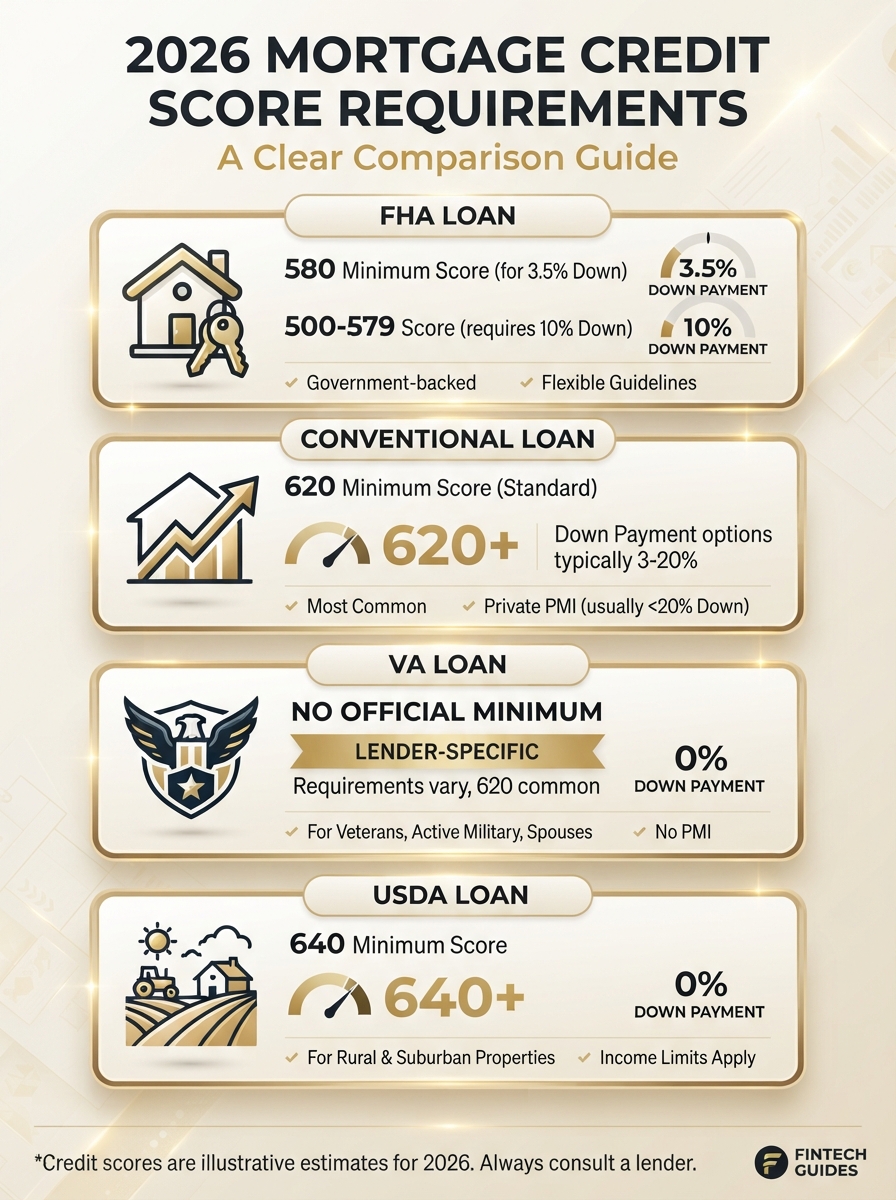
Every mortgage program has its own minimum credit score benchmark. These are set by the agencies that back or insure the loans, not by individual banks. However, individual lenders may add their own "overlays" — meaning they may require a higher score than the official minimum.
Here's a side-by-side comparison of the major loan types for 2026:
| Loan Type | Minimum Score | Below That Score | Key Notes |
|---|---|---|---|
| FHA Loan | 580 (3.5% down) | 500–579 with 10% down (lender discretion) | Most accessible path for first-time buyers with limited credit history. |
| Conventional (Fannie Mae / Freddie Mac) | 620 | Not eligible below 620 | Standard private-market loan; PMI cancellable once equity reaches 20%. |
| VA Loan (Veterans) | No official minimum | Lender overlays typically 580–620 | Zero-down option for eligible service members and veterans. |
| USDA Loan (Rural) | 640 (lender discretion) | Not eligible below 640 with most lenders | Zero-down for eligible rural and suburban properties. |
Mortgage Readiness Self-Assessment Quiz
Check each statement that applies to your current situation. The results will show whether you're on track for FHA, Conventional, or both.
2. Can You Buy a House With Bad Credit?
The short answer: yes, it may be possible — but eligibility is not the same as readiness.
The FHA program allows scores as low as 500 with a 10% down payment. That's the official floor. But here's what most articles don't explain:
- Eligibility means you meet the minimum threshold to apply. It does not mean a lender will approve you.
- Readiness means your overall financial profile — credit history, debt-to-income ratio, employment stability, and savings — supports a sustainable mortgage payment.
- Cost difference: A lower score doesn't just affect approval odds — it dramatically increases your interest rate, which can cost tens of thousands of dollars over the life of the loan.
If your score is below 620, the most practical path is usually an FHA loan. But before you apply, it's worth reviewing your credit reports to understand what's on them and whether any items may be inaccurate, incomplete, or outdated — because even a small improvement in your score can unlock a better rate.

3. FHA Requirements & Why 580 Is a Benchmark, Not a Guarantee
The Federal Housing Administration (FHA) insures loans made by approved lenders, which reduces the lender's risk and allows them to offer loans to borrowers with lower credit scores and smaller down payments.
The 580 benchmark matters because it's the threshold for the 3.5% down payment tier. Here's how it breaks down:
- 580 or above: You qualify for the 3.5% down payment option (the most common FHA path).
- 500–579: You may still qualify, but you'll need a 10% down payment. Many lenders do not offer this tier.
- Below 500: Not eligible for FHA-insured financing.
But here's the critical distinction: 580 is a benchmark, not a guarantee. The FHA sets the floor, but the lender you work with may require a higher score (called a "lender overlay"). Most FHA lenders in 2026 set their practical minimum between 580 and 620.
Additionally, your credit score is only one factor. Lenders also evaluate your debt-to-income (DTI) ratio, employment history, savings reserves, and the property's appraised value. A 580 score with a 45% DTI and unstable income may still be denied, while a 580 score with a 35% DTI and two years of steady income may be approved.
4. Three Plain-English Fixes to Review Before Applying
Before you apply for any mortgage, there are three areas of your credit file worth reviewing. These are educational, self-help steps — not promises of score increases or guaranteed outcomes.
Review Your Reports for Inaccuracies
Pull your credit reports from all three bureaus (Experian, Equifax, and TransUnion) at AnnualCreditReport.com. Look for:
- • Accounts you don't recognize
- • Late payments that may be incorrectly reported
- • Balances that don't match your records
- • Duplicate entries for the same account
- • Accounts that should have fallen off after 7 years
Under the Fair Credit Reporting Act (FCRA), you have the right to dispute information you have a good-faith basis to believe is inaccurate, incomplete, or unverifiable. This is a consumer-administered, self-help process — you submit the dispute yourself directly to the bureau.
Optimize Your Credit Utilization
Credit utilization is the percentage of your available credit that you're currently using. It's the second most important factor in your FICO score after payment history.
- • Below 30% is the general target for most scoring models
- • Below 10% is ideal for mortgage readiness
- • Pay down balances before the statement closing date, not just the due date
- • The "All Zero Except One" (AZEO) method involves reporting $0 on all cards except one, which reports a small balance
Key insight: Credit card balances are reported to bureaus on your statement closing date — not your payment due date. If you wait until the due date to pay, the higher balance may already be reported.
Avoid These Common Pre-Application Mistakes
Three things that can derail a mortgage application even with a qualifying score:
- • Don't open new credit accounts in the 90 days before applying — new inquiries and accounts can lower your score and raise lender concerns
- • Don't close old credit cards — closing accounts reduces your total available credit (spiking utilization) and shortens your average age of accounts
- • Don't leave active dispute remarks on your file when applying for a mortgage — automated underwriting systems (DU/LP) may flag disputed accounts and trigger manual review delays
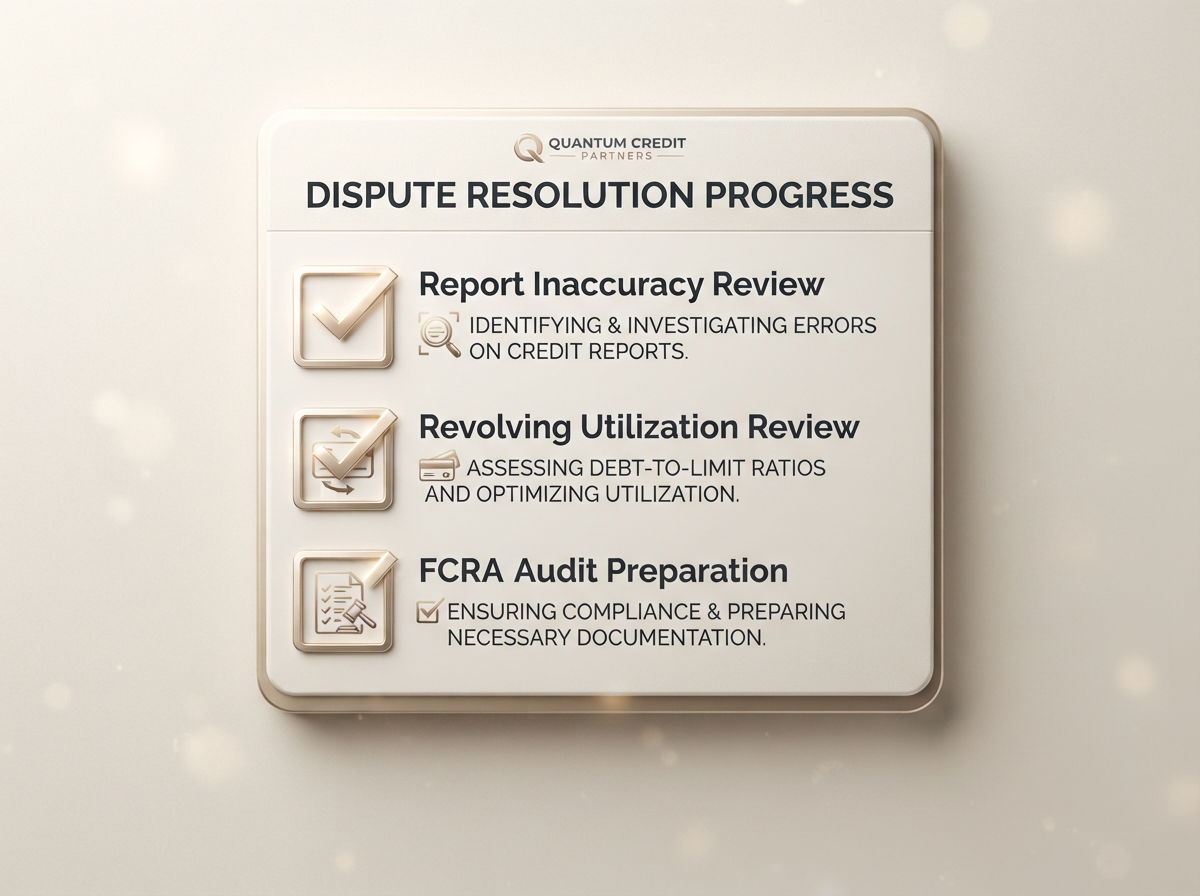
3-Step Pre-Application Credit Checklist
Work through this checklist before you contact a lender. Each item you complete puts you in a stronger position.
5. How Credit Scores Impact Mortgage Rates (The $300K Breakdown)
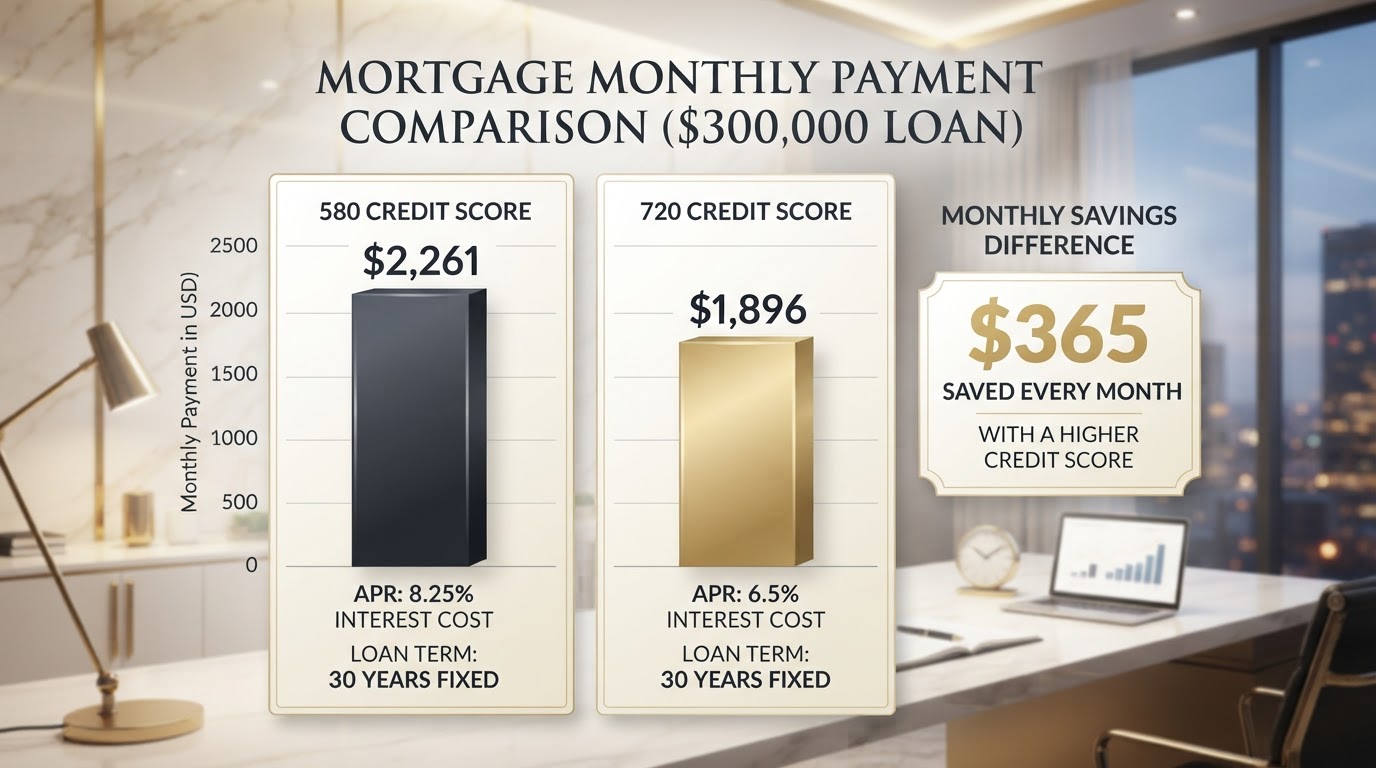
Your credit score doesn't just determine whether you qualify — it determines how much your loan costs you every month and over the life of the loan. Even a 60-point difference can translate to tens of thousands of dollars.
Here's an illustrative comparison on a $300,000 30-year fixed-rate mortgage. (Note: these are educational examples, not current rate quotes. Actual rates vary daily and by lender.)
| Credit Score Range | Est. APR | Monthly Payment | Total Interest (30 yr) | Cost vs. 720+ |
|---|---|---|---|---|
| 760–850 | 6.50% | $1,896 | $382,637 | Baseline |
| 700–759 | 6.75% | $1,945 | $400,337 | +$17,700 |
| 680–699 | 7.00% | $1,996 | $418,438 | +$35,801 |
| 660–679 | 7.25% | $2,047 | $437,015 | +$54,378 |
| 620–639 | 7.75% | $2,153 | $474,953 | +$92,316 |
| 580–619 | 8.25% | $2,261 | $513,819 | +$131,182 |
Try It Yourself: FICO® Score Paydown Simulator
Want to see how paying down your credit card balances and other preparation actions could shift your qualifying mortgage score? Use the interactive simulator below to estimate your potential score improvement and monthly payment savings. This is an educational estimation tool — not a guarantee of actual score changes.
Mortgage FICO® 2/4/5 Score Simulator
Estimate how key credit preparation actions (AZEO, dispute remark removal, AU audits) shift your qualifying tri-merge middle score and lower your 30-year interest rate.
1Input Your Current Baseline Mortgage FICO Scores
Classic Mortgage Models2Toggle Credit Preparation Actions to Simulate Improvement
2 Actions ActiveExecute AZEO Method (Revolving Utilization < 1%)
Pay revolving balances down to $0 on all cards except one card reporting 1% balance ($10-$20).
Purge Active Dispute Remarks (Code XB/XC)
Remove dispute tags from open accounts to clear Automated Underwriting System (DU/LPA) hard stops.
Remove High-Balance Authorized User Account
Remove borrower from an AU credit card with high balance that inflates DTI or carries late history.
Clean Up Recent Hard Inquiries (< 120 Days)
Audit permissible purpose for non-extension inquiries or freeze bureaus during pre-approval.
Purge Medical Collections (< $500 or Paid)
Delete paid or under-$500 medical collection accounts under national credit bureau reporting rules.
Tri-Merge Qualifying Middle Score Shift
Estimated 30-year cumulative interest savings: $93,216 on a $380,000 loan.
This is also why it's worth taking the time to understand your credit file before applying — not to chase a perfect score, but to make sure there are no avoidable errors dragging you into a higher rate tier than you deserve.
Get Your Credit File Organized Before You Apply
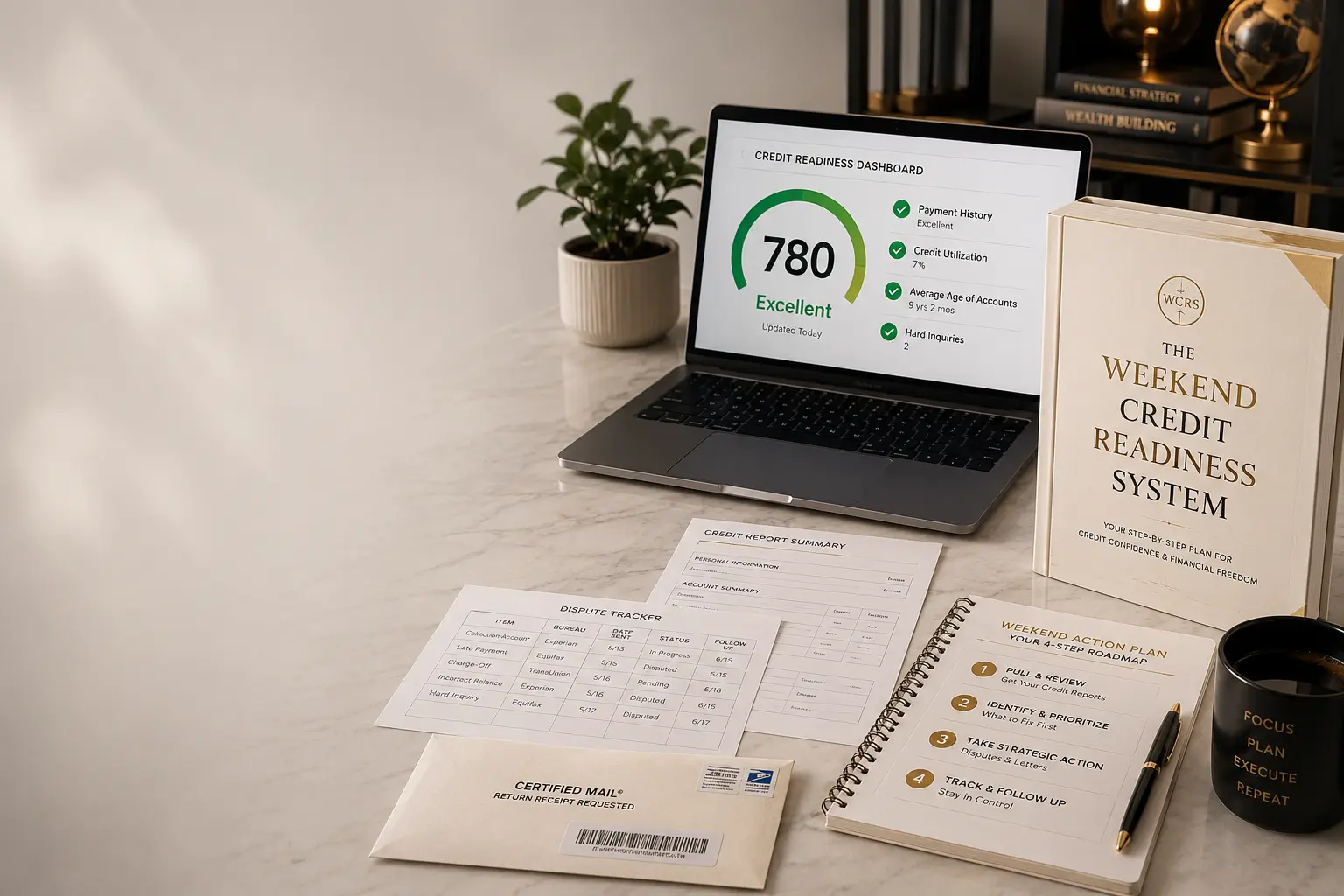
The Weekend Credit Readiness System is a 35-page educational blueprint that helps you review your credit reports, identify potential reporting inaccuracies, understand which issues may be worth investigating, and organize your next steps using structured templates and AI-assisted tools.
Instant digital access • One-time payment • Educational self-help system
Frequently Asked Questions
What credit score do I need to buy a house in 2026?
The minimum depends on your loan type. FHA loans require at least 580 for a 3.5% down payment. Conventional loans typically require 620. VA and USDA loans have no official minimum but most lenders look for 580–640.
Can I buy a house with bad credit?
You may be eligible for an FHA loan with a score as low as 500 if you put 10% down, but eligibility does not guarantee approval. Lenders also evaluate debt-to-income ratio, employment history, and down payment funds.
How can I raise my credit score for a mortgage?
Focus on three areas: review your reports for inaccuracies and exercise your FCRA rights to dispute errors, lower your credit card balances below 30% of limits, and avoid new credit applications or closing accounts before applying.
What is the difference between FHA and Conventional loan credit requirements?
FHA loans are government-insured and allow scores as low as 580 with 3.5% down, making them more accessible for first-time buyers. Conventional loans are backed by Fannie Mae and Freddie Mac, typically requiring 620+, but offer benefits like no mortgage insurance once you reach 20% equity.
Legal Disclosures & Compliance
Educational Content Notice: This article is published by Everything AI, LLC strictly for educational and informational purposes. Everything AI, LLC is not a law firm, credit repair organization, mortgage lender, or financial advisory firm. We do not provide legal representation, credit repair services, mortgage lending, or certified financial planning.
No Guarantee of Results: Individual consumer credit profiles, mortgage rates, and lender decisions vary. No credit score increase, loan approval, account deletion, or removal of accurate and verifiable information is promised or guaranteed. The mortgage rate examples in this article are illustrative only and do not represent current market rates or offers.
FCRA Rights: Under the Fair Credit Reporting Act (15 U.S.C. § 1681 et seq.), consumers have the right to dispute information they have a good-faith basis to believe is inaccurate, incomplete, or unverifiable. All dispute strategies discussed in this article are consumer-administered, self-help educational steps.
CROA & FTC Compliance: In compliance with the Credit Repair Organizations Act and FTC regulations, we do not charge upfront fees for credit repair performance services, nor do we act as an intermediary to alter your credit file on your behalf.
Trademark & Regulatory Attribution: FICO, Equifax, Experian, TransUnion, FHA, Fannie Mae, Freddie Mac, VA, and USDA are registered trademarks of their respective entities. Everything AI, LLC is not affiliated with, endorsed by, or sponsored by these agencies. Copyright © 2026 Everything AI, LLC. All rights reserved.