
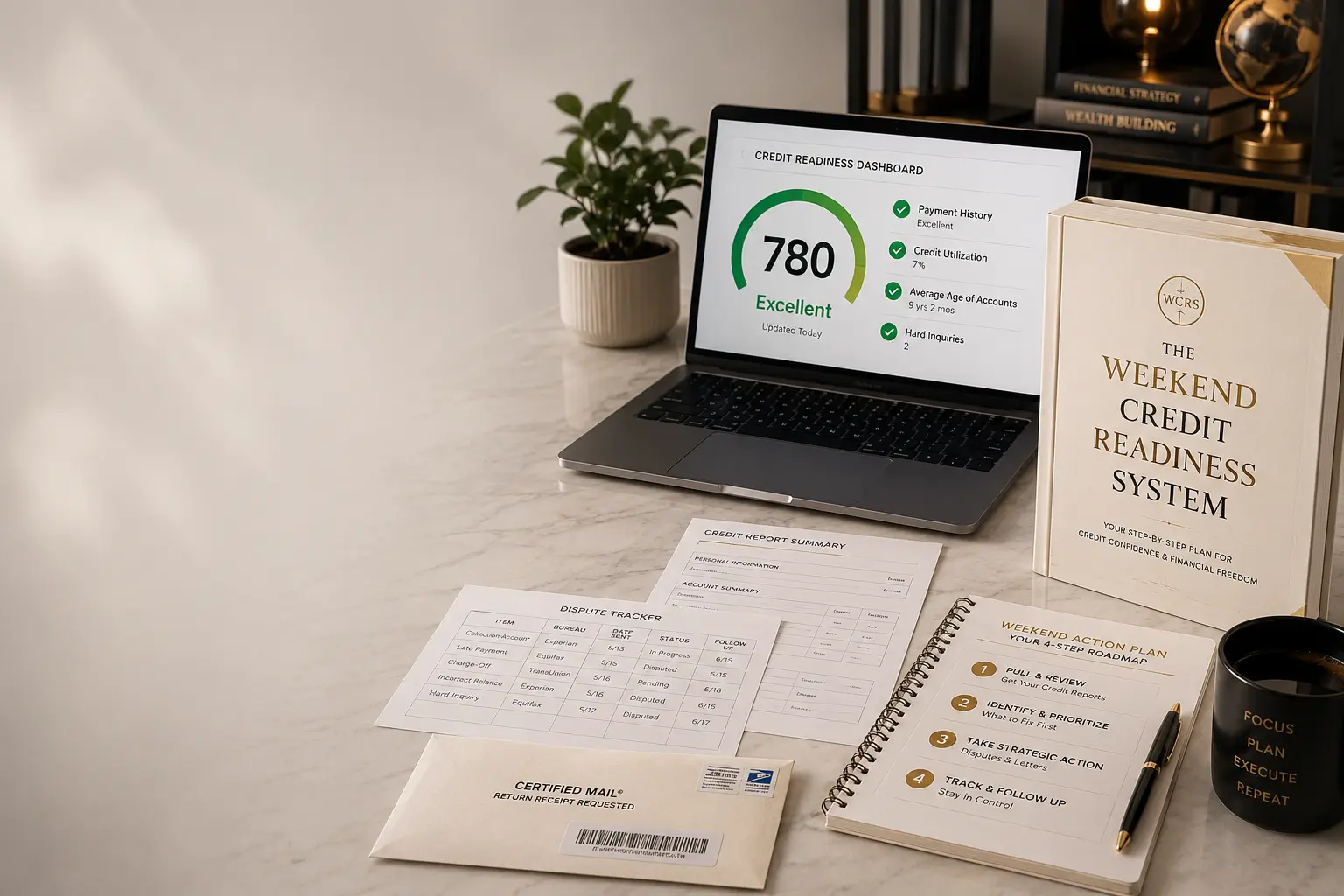

Executive Summary
You gathered your raw credit reports, identified clear Metro 2 reporting errors, drafted a factual dispute, and sent it via USPS Certified Mail. You tracked the green card, saw the signature, and waited patiently.
Then day 30 passed. Instead of receiving a notice that the inaccurate account was deleted, you received a generic computer-generated form letter stating your dispute was deemed "frivolous or irrelevant," or simply that the data was "magically verified."
This is not a dead end; it is a standard corporate stalling tactic designed to make most consumers give up. When consumer reporting agencies (Equifax, Experian, TransUnion) stall, they may trigger specific legal liabilities under the Fair Credit Reporting Act (FCRA). Here is your step-by-step educational playbook to help you exercise your FCRA rights and navigate the dispute process independently.
1The Statutory 30-Day Clock (15 U.S.C. § 1681i(a)(1))
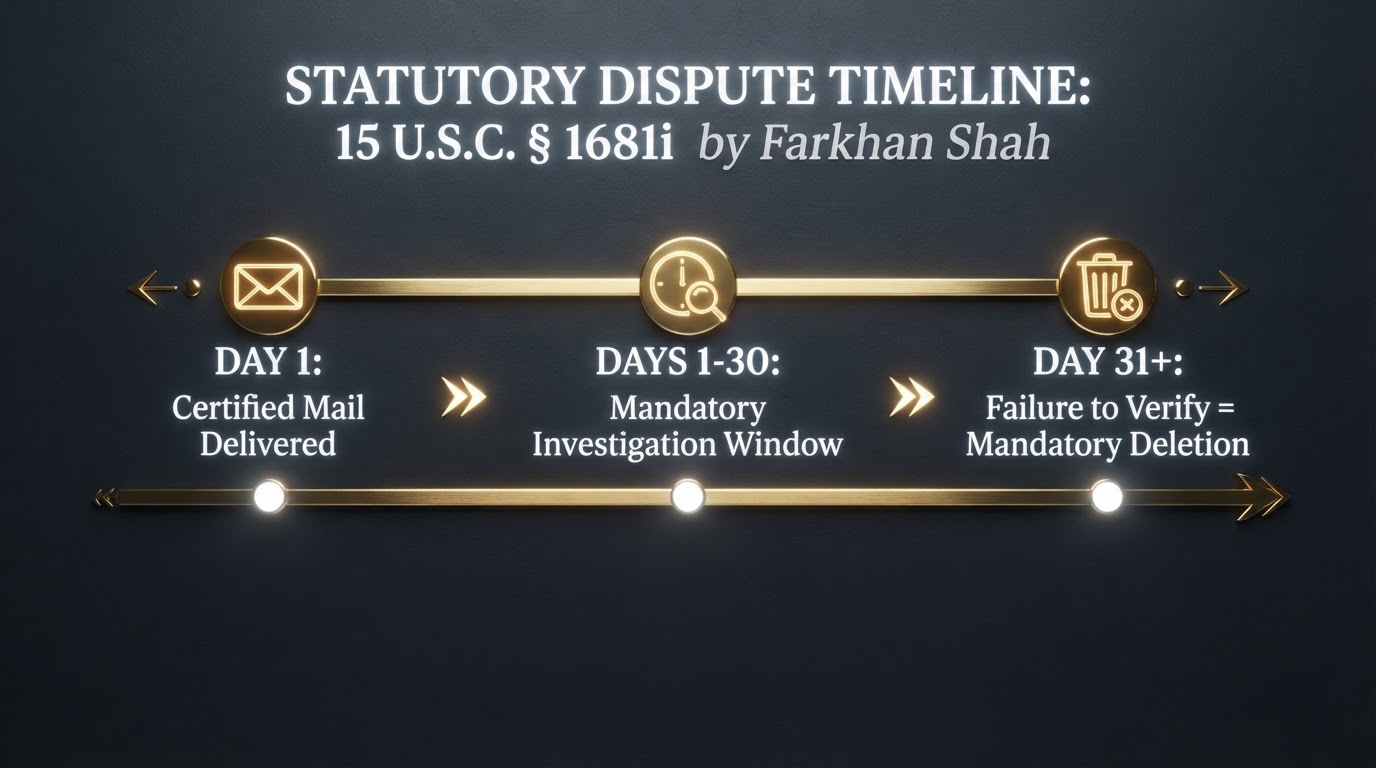
Under FCRA § 611(a)(1), consumer reporting agencies have a strict statutory window of 30 days from the date they receive your dispute to complete a reasonable investigation.
- The Certified Mail Rule: Never dispute online or via standard mail. Your certified mail return receipt establishes the legally binding "Day 1."
- The 15-Day Trap: If you send additional information to the bureau during an active 30-day investigation, the bureau gets an extra 15 days (extending the clock to 45 days). Do not send piecemeal follow-ups during the initial window.
- Mandatory Deletion Clause: If 30 calendar days pass from the date of confirmed delivery and the bureau has not provided a completed reinvestigation response, the item may be eligible for deletion as unverified under 15 U.S.C. § 1681i(a)(5)(A). This is a self-help, DIY educational process.
30-Day USPS Certified Mail Dispute & Escalation Log Generator
Track your certified mail delivery date, calculate mandatory FCRA § 611 statutory deadlines, and generate instant CFPB complaint logs.
FCRA Statutory Milestone Deadlines
Certified mail signed. 30-day statutory clock officially starts under FCRA § 611.
Bureau cutoff to issue FCRA § 612 frivolous notice specifying exact rejection reasons.
If unverified by this date, FCRA § 611(a)(5)(A) mandates immediate tradeline deletion.
15-day limit for bureau to supply furnisher contact & procedure records under FCRA § 609 MOV.
Allow Equifax Information Services until Sep 13, 2026 to complete reinvestigation. Do not send additional mail during this window to avoid the +15 day extension trap.
2Dismantling the Automated "Frivolous" Rejection Code
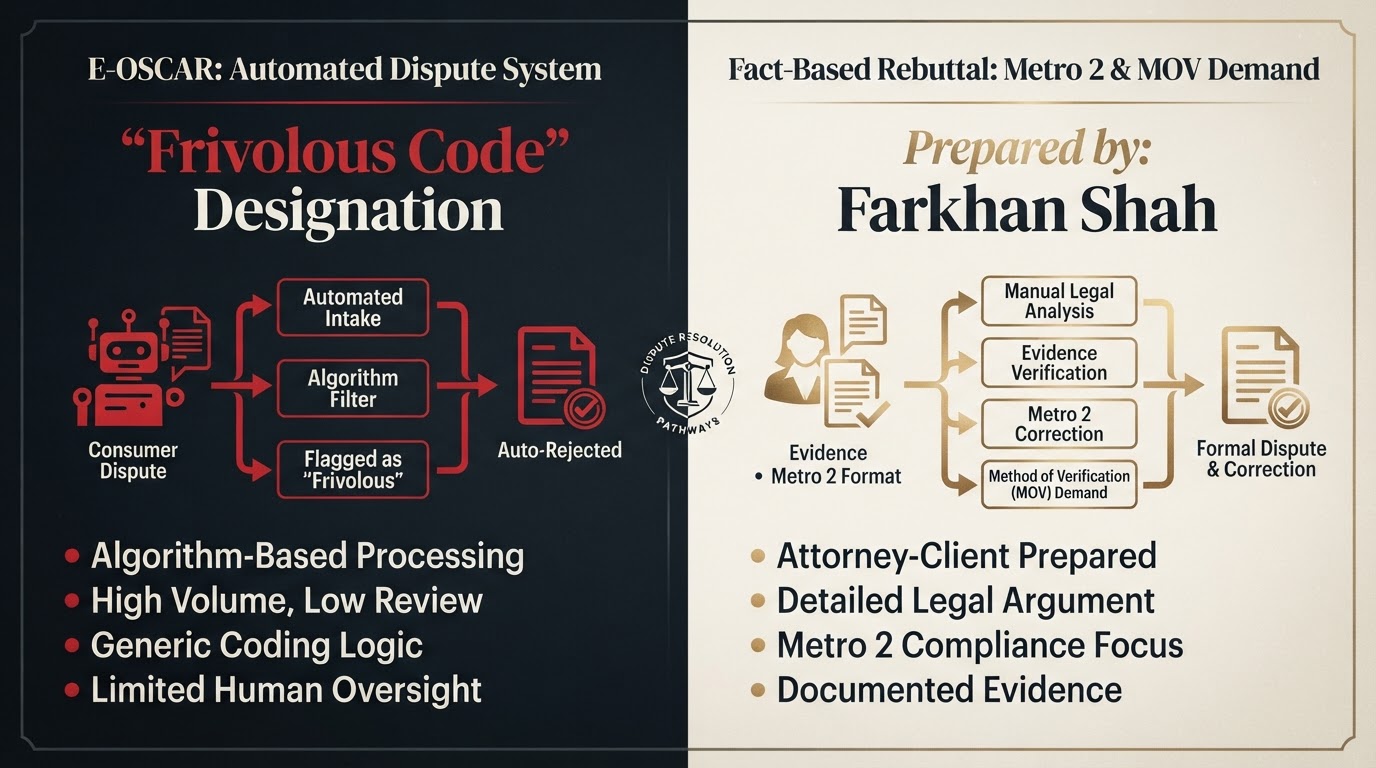
When bureaus use e-OSCAR automated scanners, generic letters trigger an immediate rejection code under FCRA § 612 (15 U.S.C. § 1681i(a)(3)), claiming your dispute is "frivolous or irrelevant."
How to Rebut a "Frivolous" Classification:
- Demand Specificity: Section 612 requires the bureau to notify you within 5 business days and state the exact reason why the dispute was deemed frivolous.
- Provide Factual Rebuttal: Re-issue your dispute immediately with bolded header text:
"NOTICE OF FACTUAL DISPUTE: This is not a template dispute. This is a factual, data-driven dispute citing specific Metro 2 field contradictions (Account Status Code vs Payment Rating Code mismatch). Under FCRA § 611, you are legally obligated to conduct a reasonable investigation with the furnisher."
3Executing a Method of Verification (MOV) Demand (15 U.S.C. § 1681i(a)(7))
If the bureau claims an inaccurate account was "verified" without changing any data fields, they have likely performed an automated "rubber-stamp" verification through e-OSCAR without inspecting real physical or electronic records.
Your next move is to issue a formal Method of Verification (MOV) demand under FCRA § 611(a)(7). Legally, the bureau must provide you within 15 days:
- The business name, address, and phone number of the specific individual at the furnishing company contacted during the investigation.
- The exact description of the procedure used to determine the accuracy of the data.
FCRA § 609 / § 611 Legal Requirement Checker
Audit your dispute strategy against federal statutory standards to ensure maximum legal leverage under 15 U.S.C. § 1681g and 15 U.S.C. § 1681i before mailing.
Your current approach lacks statutory force under FCRA § 611. Bureaus will likely respond with a rubber-stamp 'Verified' or 'Frivolous Dispute' template letter.
Formally requested all underlying data, source documents, and furnisher records held in bureau files.
Sent via USPS Certified Mail with signature confirmation establishing day-1 receipt proof.
Dispute cites specific Metro 2 fields (e.g. Account Status vs Payment Rating or DOFD re-aging error).
Includes original factual documentation and avoids generic template quotes that trigger e-OSCAR auto-rejection.
If verified without change, demands business name, address, phone number, and procedure description within 15 days.
Includes statutory language demanding immediate deletion if unverified within the 30-day statutory window.
FCRA § 609 / § 611 Method of Verification (MOV) Generator
Generate a legally binding Method of Verification demand letter under 15 U.S.C. § 1681i(a)(7) to force credit bureaus to supply physical furnisher contact details or delete rubber-stamped accounts.
Target Bureau & Disputed Tradeline
Consumer Info & Specific Inaccuracy
Johnathan Doe
123 Financial Freedom Way, Suite 400
Austin, TX 78701
SSN (Last 4): XXX-XX-6789 | DOB: 01/15/1985

DATE: August 26, 2026
VIA USPS CERTIFIED MAIL w/ RETURN RECEIPT

TO:
Equifax Information Services LLC
P.O. Box 740256
Atlanta, GA 30374

RE: FORMAL METHOD OF VERIFICATION (MOV) DEMAND PURSUANT TO 15 U.S.C. § 1681i(a)(7) & 15 U.S.C. § 1681g
Prior Dispute Submission Date: June 12, 2026
USPS Certified Mail Tracking #: 7020 0640 0001 2345 6789
Disputed Account / Furnisher Name: Midland Credit Management
Account Number: 4829-XXXX-8910

Dear Compliance Director,

I am writing to formally exercise my statutory consumer rights under the Fair Credit Reporting Act (FCRA), specifically 15 U.S.C. § 1681i(a)(7) and 15 U.S.C. § 1681g (Section 609).

On June 12, 2026, your agency received my certified written dispute regarding the inaccurate tradeline referenced above. Your agency subsequently returned a response stating that the account was "Verified." However, your notice failed to include the legally mandated description of the procedure used to determine the accuracy of the disputed item.

1. STATUTORY DEMAND FOR METHOD OF VERIFICATION (15 U.S.C. § 1681i(a)(7))
Pursuant to FCRA § 611(a)(7), I hereby demand that your agency provide me, within fifteen (15) calendar days of receipt of this notice:
a) The exact business name, physical street address, and direct telephone number of the specific individual or department at Midland Credit Management contacted during your reinvestigation.
b) A written description of the verification procedure utilized, including whether the verification was conducted electronically via an automated e-OSCAR Automated Dispute Verification (ADV) code or through physical document inspection.
c) Copies of the underlying source documents (signed credit application, payment history ledger, or original contract) provided by Midland Credit Management to substantiate accuracy.

2. SPECIFIC FACTUAL INACCURACY
The item in question remains legally unverifiable and non-compliant due to:
The bureau issued a generic 'Verified' response without supplying the physical source documents, signed contract, or payment history records provided by the furnisher.

3. NOTICE OF MANDATORY DELETION (15 U.S.C. § 1681i(a)(5)(A))
Under 15 U.S.C. § 1681i(a)(5)(A), if disputed information cannot be verified through complete, documented source evidence within the statutory timeframe, your agency is legally required to PROMPTLY DELETE THAT ITEM from my credit file. An automated e-OSCAR "rubber-stamp" code does not satisfy the legal standard of a reasonable investigation under 15 U.S.C. § 1681i(a)(1).

Please send your full Method of Verification disclosure and updated credit report reflecting the immediate deletion of this unverified item to my address above within 15 days.

Sincerely,

________________________________________
Johnathan Doe
Navigating Credit Bureau Stall Tactics?
Learn to identify reporting inaccuracies and exercise your FCRA rights when dealing with automated form letters. Get our educational Method of Verification (MOV) templates and escalation workflows.
4Escalating to the Consumer Financial Protection Bureau (CFPB)
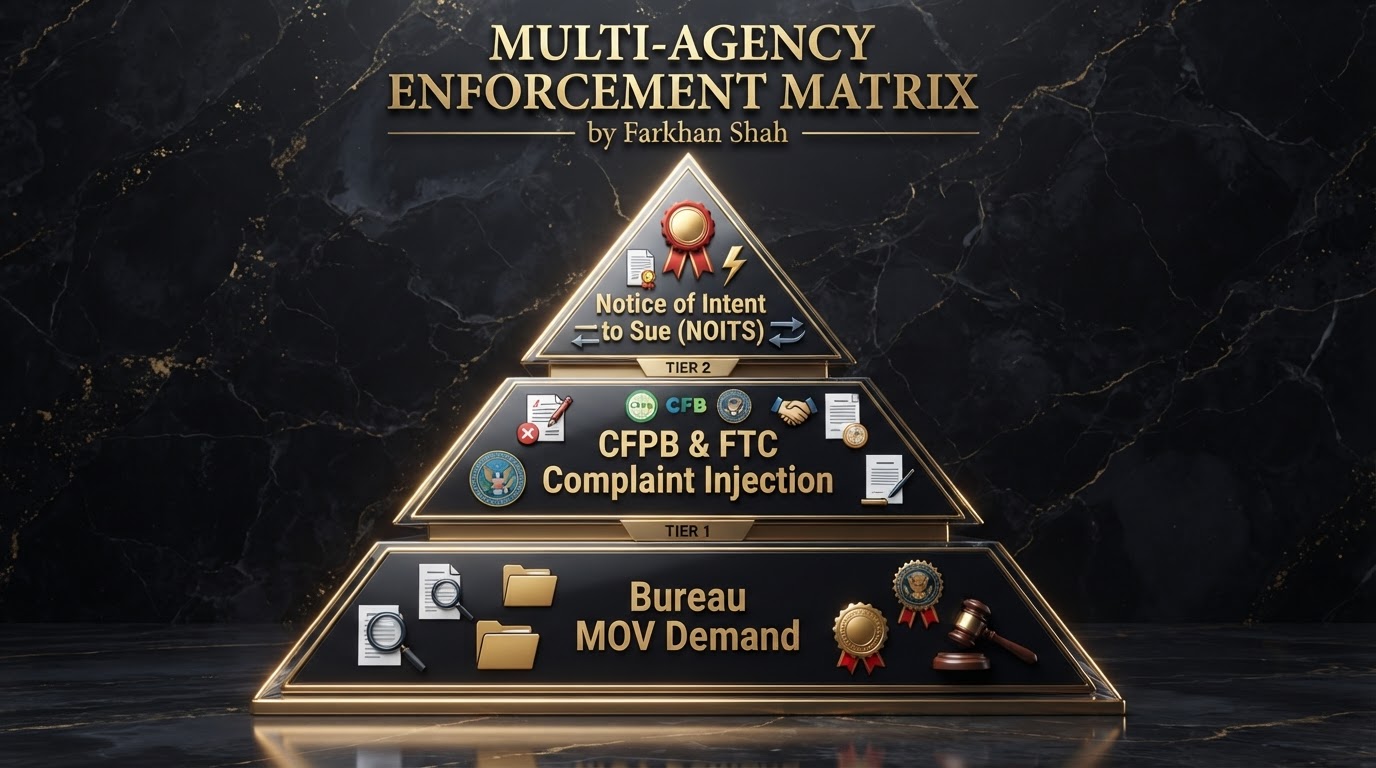
When a credit bureau ignores an MOV request or exceeds the 30-day investigation timeline, informal requests are over. It is time to file a formal regulatory complaint with the Consumer Financial Protection Bureau (CFPB).
How to File a High-Impact CFPB Complaint:
- Select Credit Reporting as the primary issue and "Incorrect information on your report" or "Problem with a bureau's investigation" as the sub-issue.
- Attach 3 mandatory PDF proofs:
- Copy of your original dispute letter.
- Copy of your USPS Certified Mail green card / delivery confirmation showing the date received.
- Copy of the bureau's non-compliant or stall response letter.
- State clearly in the narrative:
"The credit bureau has failed to conduct a reasonable investigation under 15 U.S.C. § 1681i, failed to respond within the statutory 30-day timeline, and failed to provide a valid Method of Verification upon request. I request deletion of this unverified record per 15 U.S.C. § 1681i(a)(5)(A)."
CFPB Complaint Narrative Builder
Build a legally grounded regulatory narrative to submit directly to consumerfinance.gov when credit bureaus stall or ignore disputes.
5The FTC & State Attorney General Double-Barrel Strategy
To maximize regulatory pressure, file parallel complaints with:
- The Federal Trade Commission (FTC): Submitting an FTC Fraud & Compliance report generates an official report number that proves you are pursuing formal regulatory channels.
- Your State Attorney General (Consumer Protection Division): State AG offices oversee credit reporting violations under state-level Unfair and Deceptive Acts and Practices (UDAP) laws. Adding your State AG complaint reference number to your bureau communications signals immediate legal risk.
6Notice of Intent to Sue (NOITS) & FCRA Statutory Damages
If regulatory complaints do not produce a resolution, your final administrative step before potential litigation is issuing a Notice of Intent to Sue (NOITS). This is a self-help, DIY educational process.
Under FCRA § 616 (15 U.S.C. § 1681n), willful non-compliance by a credit reporting agency exposes them to:
- Statutory damages between $100 and $1,000 per violation.
- Actual damages suffered by the consumer (e.g., mortgage denial, higher interest rates).
- Mandatory payment of the consumer's attorney fees and legal costs.
A formal NOITS detailing your paper trail (Certified Mail Receipt → Frivolous Rejection → MOV Demand → CFPB Complaint Number) gets routed directly to the bureau's legal compliance department rather than an automated offshore scanner.
7Demanding Immediate Deletion & Purging the File
When a bureau fails to meet its statutory duties, you may cite 15 U.S.C. § 1681i(a)(5)(A) in your final demand letter and CFPB response to exercise your FCRA rights:
"If an item of information disputed by a consumer is found to be inaccurate or incomplete or cannot be verified, the consumer reporting agency shall promptly delete that item of information from the file of the consumer..."
Choose Your Path to Credit Clarity
Every consumer's credit situation and schedule are unique. We offer two powerful ways to clean up inaccurate reporting:
The Master DIY Dispute Blueprint
Perfect for self-starters who want to handle everything independently using complete statutory templates and guidelines.
- 35-Page Operational Guide: Full breakdown of FCRA laws, Metro 2 codes, and tracking procedures.
- 21 Copy & Paste Statutory Templates: Rebuttal letters, MOV demands, CFPB complaint formats, and NOITS drafts.
- Certified Mail Tracking Worksheets: Step-by-step logging tools to enforce the 30-day clock.
1-on-1 VIP Strategy Consultation
Ideal for busy individuals who want expert alignment, personal credit file reviews, and dedicated guidance through bureau responses.
- Complete $17 DIY System Included: Receive the full 35-page guide and 21 templates at no added cost.
- Personalized Credit File Review: Analyze your unique credit bureau stall letters and Metro 2 discrepancies together live.
- Custom Step-by-Step Action Plan: Walk away from your private consultation with a clear 90-day roadmap.
Frequently Asked Questions (FAQs)
Compliance FAQ & Legal Lookup Engine
Instant real-time search across FCRA statutes, Metro 2 fields, e-OSCAR rules, and regulatory escalation guidelines.
e-OSCAR uses Optical Character Recognition (OCR) scanners to parse dispute letters into 2-digit Automated Dispute Verification (ADV/ACDV) codes. Generic internet templates containing phrases like 'Validate this debt' or 'Not mine' trigger e-OSCAR Frivolous Dispute Rejection Codes under FCRA § 612 (15 U.S.C. § 1681i(a)(3)), allowing credit bureaus to dismiss the dispute without contacting the bank.
What happens if a credit bureau does not respond within 30 days?
Under FCRA § 611(a)(5)(A), if a credit bureau fails to complete its reinvestigation within 30 calendar days of receiving your dispute, the disputed item is legally unverified and must be deleted immediately.
How do I legally prove the bureau received my dispute letter?
You must send all formal disputes via USPS Certified Mail with Return Receipt Requested. The delivery date stamped on your tracking receipt or signed green card serves as legal proof of "Day 1."
Why did the bureau call my dispute "frivolous" and how do I fix it?
Bureaus use automated e-OSCAR scanners that trigger "frivolous" template letters when disputes look like generic online forms. Submit a factual, data-driven dispute citing specific Metro 2 field errors and explicitly state that it is a statutory notice under FCRA § 611.
Is the $17 Master Blueprint sufficient, or do I need the $197 Strategy Session?
The $17 Master Blueprint contains all the educational templates and statutory logic necessary to help you exercise your FCRA rights independently. If you feel comfortable handling mail logs and forms, the $17 blueprint is all you need. If you prefer expert guidance, personal file review, and 1-on-1 support to evaluate complex bureau responses, the $197 Strategy Session gives you direct expert collaboration.
Credit Bureau Dispute Flowchart Generator
Visualize and document your multi-round FCRA escalation strategy step-by-step. Add each round, track bureau responses, and export your complete dispute timeline.
15 U.S.C. § 1681i(a)(1)
Educational tool only. Not legal advice. © 2026 Everything AI LLC.
Legal Disclosures & Operational Compliance
Educational Content Notice: The articles, software tools, digital templates, and blueprints provided on creditrepair.everythingainow.com are published by Everything AI LLC strictly for educational, informational, and self-help purposes. Everything AI LLC, Farkhan Shah, and its affiliates are not a law firm, credit repair organization (CRO) as defined under local or federal statutes, or financial advisory firm, and do not provide formal legal representation, credit repair services, or certified financial planning.
No Guarantee of Results: Individual consumer credit profiles, history, and statutory responses vary. Federal laws such as the Fair Credit Reporting Act (FCRA) (15 U.S.C. § 1681 et seq.) grant consumers the right to dispute inaccurate, incomplete, or unverifiable data directly with Consumer Reporting Agencies (Equifax, Experian, TransUnion). However, no software, template, or guide can guarantee the removal of 100% accurate, timely, and fully verifiable negative tradelines or bankruptcy records prior to their statutory expiration dates.
Credit Repair Organizations Act (CROA) & FTC Compliance: In compliance with FTC regulations and federal consumer protection statutes, we do not charge upfront fees for credit repair performance services, nor do we act as an intermediary to alter your credit file on your behalf. All tools and templates provided are designed to empower you to execute your own lawful, factual disputes directly.
Trademark & Regulatory Attribution: Equifax, Experian, TransUnion, e-OSCAR, CFPB, and FTC are registered trademarks of their respective corporate entities. Everything AI LLC is an independent software and educational publisher and is not officially affiliated with, endorsed by, or sponsored by these agencies. Copyright © 2026 Everything AI LLC. All rights reserved.
📦 The Master FCRA Escalation & Dispute Suite
Stop guessing how to respond when credit bureaus send stall letters. Get access to educational escalation templates designed to help you exercise your FCRA rights and identify reporting inaccuracies.
- Complete Method of Verification (MOV) Demand Letters
- CFPB Complaint Formatting Templates & Evidence Checklists
- Notice of Intent to Sue (NOITS) Drafts for Bureau Legal Teams
- 30-Day Certified Mail Tracking Worksheets
Final Thoughts
The credit dispute process is not a battle of persuasion—it is a process of statutory compliance and documentation. By maintaining a thorough paper trail, tracking the 30-day clock, and escalating through regulatory channels, you exercise your FCRA rights as a consumer. This is a self-help, DIY educational process.