

How to Raise Your Credit Score Fast: 5 Legitimate Moves to Make Before Your Next Application

VEOL Asset 1: WebP · 1200×675 (16:9) · <100KB · File: how-to-raise-credit-score-fast-legitimately.webp · Pinterest: "How to Raise Your Credit Score Faster Without Falling for Credit Hacks" · Board: Credit Score & Financial Readiness
There is no legitimate method that guarantees a specific credit-score increase within a specific timeframe. However, consumers can promptly review their credit reports for inaccuracies, dispute information they reasonably believe is inaccurate or incomplete under the FCRA, reduce revolving credit utilization, avoid unnecessary new debt, and organize supporting documentation before their next application. Credit reporting companies generally investigate disputes within 30 days.
You didn't search "how to raise credit score fast" because you're casually curious about credit.
Something is probably coming.
An apartment application. A car loan. A credit card. A mortgage conversation. Maybe even an employment screening.
And suddenly that three-digit number feels a lot more important than it did last month.
Maybe you opened your credit app and saw a score lower than you expected. Maybe a credit card is reporting a balance much higher than usual. Maybe you spotted a late payment you don't recognize. Or maybe you were already denied once and don't want to walk into the next application completely unprepared.
Here's what you need to know first:
There is no legitimate button that instantly adds points to your credit score.
Anyone promising a guaranteed overnight increase, guaranteed deletion, a new credit identity, or removal of accurate negative information should make you cautious.
But that does not mean you're powerless. There are legitimate things you can review immediately that may affect the information used to calculate credit scores.
The key word is: Review.
Because when time matters, random "credit hacks" can waste the exact thing you don't have much of: time.
So before you send another application, spend the next few minutes answering a more useful question:
What can I legitimately identify, verify, document, and improve before someone else evaluates my credit?
Here are five places to start.
1. Check Credit Utilization Before You Chase Anything Else
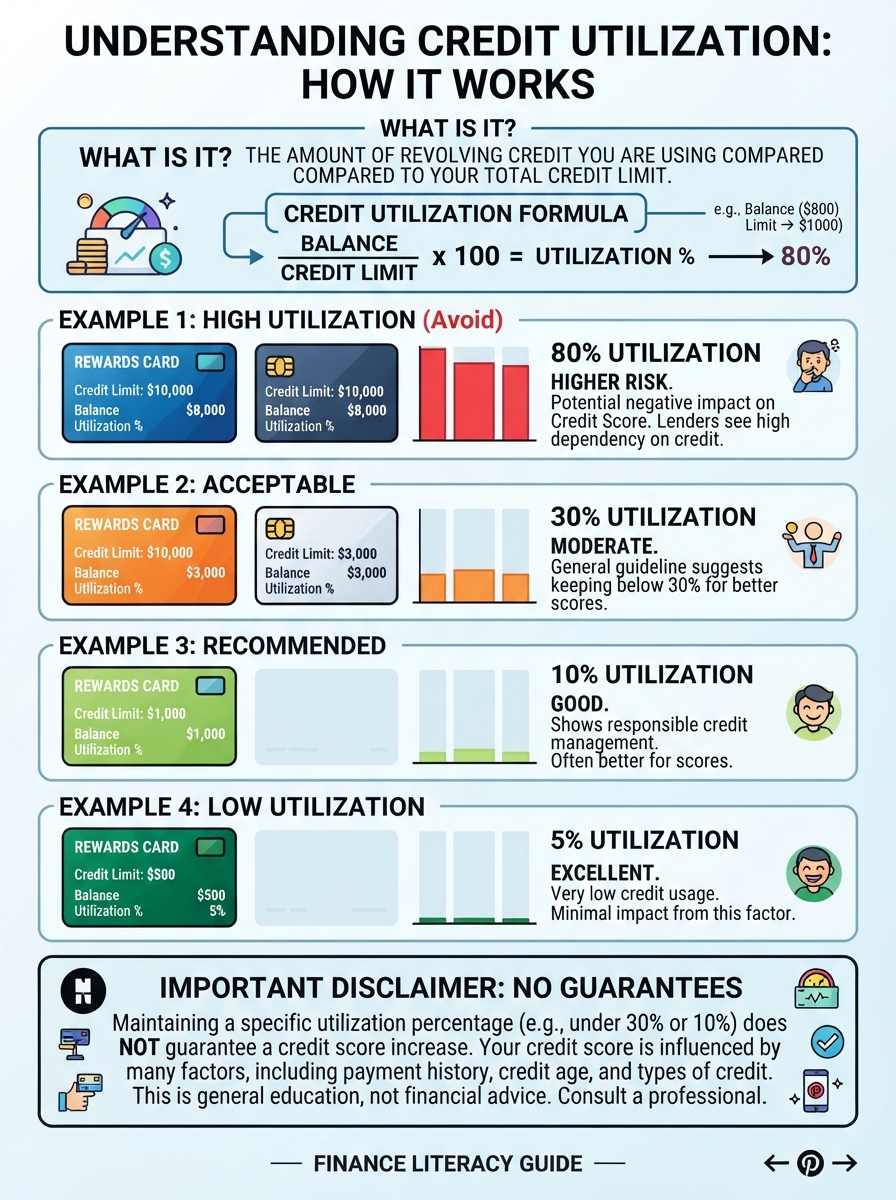
One of the first things to examine is your revolving credit utilization. That's a complicated phrase for a simple calculation:
Credit card balance ÷ credit limit × 100
If you have a card with a $1,000 limit and your reported balance is $800: $800 ÷ $1,000 = 80% utilization
If the balance were $200: $200 ÷ $1,000 = 20% utilization
Why should you care? Because revolving balances are one part of the information credit-scoring systems may evaluate.
That doesn't mean: "Get below 30% and your score will increase 50 points." Nobody can responsibly promise that. Different scoring models, different reports, and different credit histories can produce different results.
What you can do is determine exactly where you stand.
| Utilization Level | Balance on $10,000 Limit | Classification |
|---|---|---|
| 80% | $8,000 | High utilization |
| 30% | $3,000 | Common planning reference |
| 10% | $1,000 | Lower utilization reference |
| 5% | $500 | Low utilization reference |
Educational planning references only. No utilization percentage guarantees a specific credit score or score increase.
Credit Utilization Impact Calculator
Enter your total revolving credit limit and current reported balances to understand your current utilization.
Educational planning tool only. There is no universal utilization percentage that guarantees a particular credit score or score increase. Credit scoring depends on the complete credit file and scoring model being used.
VEOL Asset 2: WebP · 600×800 (2:3) · <100KB · File: credit-utilization-impact-calculator-guide.webp · Pinterest: "Credit Utilization Explained: Calculate Yours in Seconds"
What should you do with the result?
Don't panic. And don't drain your emergency savings just because an internet article told you to get every card to zero.
Instead, ask: Are unusually high revolving balances being reported right now?
If the answer is yes, determine whether paying some of those balances down is financially appropriate for you. And understand one detail many people miss:
Your reported balance may not equal the balance you see today.
Card issuers generally report account information periodically. That means paying down a card at 11:59 tonight does not automatically mean every credit report or score changes tomorrow morning.
Again: No instant-score promise. But understanding utilization gives you something much better than guessing: a number you can actually evaluate.
2. Audit Every Late Payment Before Assuming It's Correct
Now we get to one of the highest-intent searches in credit: "How to dispute a late payment."
There's an enormous difference between these two situations:
Situation A
You actually paid 30 or more days late and the creditor reported it accurately.
Situation B
You paid on time—or the reported date/status is otherwise inaccurate—but your credit report says you were late.
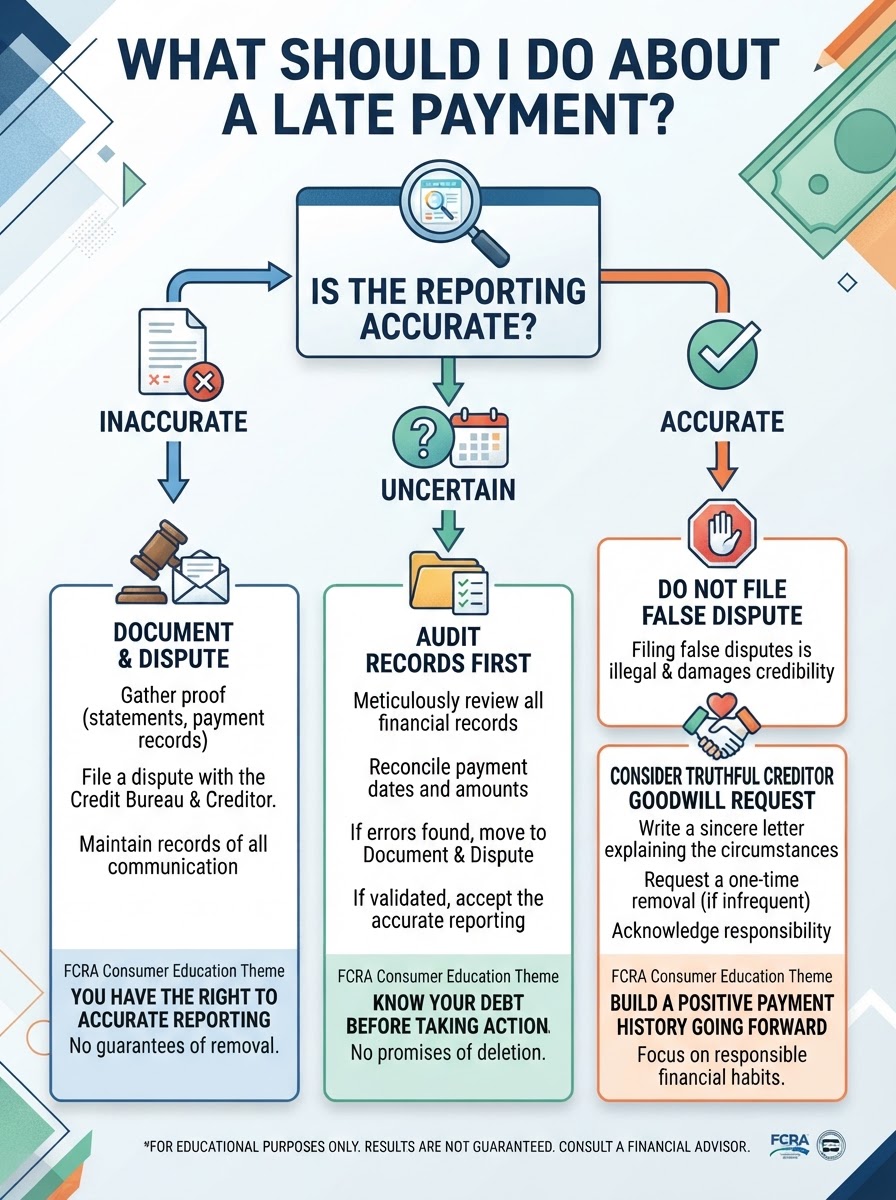
Situation B deserves your attention. Under the Fair Credit Reporting Act, you have the right to dispute information you believe is inaccurate or incomplete. The CFPB recommends disputing the information with both the credit reporting company and the company that furnished the information. You can provide an explanation and copies of supporting documents.
Don't start with "How do I remove a late payment?"
Start with: "Is this late payment being reported accurately?"
That one change in thinking matters. Because accurate current negative information generally cannot simply be removed because it hurts your score. But inaccurate information? That's exactly what the dispute process exists to address.
Late Payment Dispute Eligibility Checker
Answer three questions about the late payment you're reviewing.
VEOL Asset 3: WebP · 600×800 (2:3) · <100KB · File: how-to-dispute-late-payment-decision-tree.webp · Pinterest: "Late Payment on Your Credit Report? Check This Before You Dispute"
What happens after a legitimate dispute?
Do not expect a 48-hour deletion. Credit reporting companies generally have 30 days to investigate a credit-report dispute, and some situations can extend the investigation period to 45 days.
That's why starting earlier matters. Not because you're guaranteed a result. Because: A legitimate error sitting unnoticed on your report cannot begin being investigated until somebody identifies it.
3. If the Late Payment Is Accurate, Stop Trying to Turn It Into an "Error"
This is where a lot of bad internet advice starts. Someone tells you: "Dispute everything." "Make them prove it." "Say it was identity theft." "Use this secret letter."
Don't.
The FTC warned consumers again in 2026 about false identity-theft claims being promoted as a credit "hack." Filing a false identity-theft report can have serious legal consequences. And the CFPB says accurate negative information generally cannot be removed simply because you don't like what it does to your credit.
But what if the late payment really happened?
You have a different option you can consider: A goodwill request.
A goodwill request is not an FCRA dispute. You're not claiming the lender made an error. You're essentially saying: "The late payment is accurate. Here is what happened. Here is what changed. Would you consider making a goodwill adjustment?"
The creditor is not required to grant the request. Do not send a goodwill letter claiming information is inaccurate when you know it isn't. And do not interpret a goodwill request as a guaranteed "late payment removal strategy."
Think of it as exactly what it is: a request.
A useful goodwill request should be truthful.
Explain briefly: what happened, why the payment became late, whether the issue was unusual, what you've done since, your current payment history, and what you're asking the creditor to consider.
No fake hardship. No invented facts. No threats. No "FCRA loophole." Truth is a much stronger strategy than trying to turn accurate information into a fake dispute.
Turning what you just learned into a step-by-step process is exactly what The Weekend Credit Readiness System is built for.
A self-guided educational system for organizing your credit-readiness review. No guaranteed score increase or deletion.
Get the $17 Guide4. Understand Authorized-User Credit Before Someone Sells You a "Tradeline"
Another popular search is: "Can someone add me as an authorized user to boost my credit?"
There are legitimate authorized-user arrangements. For example, a spouse, parent, or other person may add someone as an authorized user to an account they genuinely authorize that person to use.
Whether and how that account affects a particular credit score depends on factors including whether the issuer reports authorized users and which scoring model is being used.
But there's a very different practice you should understand: Buying access to a stranger's tradeline.
That's when someone charges you money to appear as an authorized user on another person's account primarily to try to manipulate your credit profile. Do not confuse that with a normal authorized-user relationship.
The FTC has brought enforcement actions involving businesses that marketed paid "credit piggybacking" and promised substantial score improvements from stranger tradelines.
Don't buy a credit score fantasy.
If someone tells you: "Pay us and we'll add 100 points using a tradeline," the guarantee itself should be a warning.
If you're considering a legitimate authorized-user arrangement with someone you actually know, ask: Does the issuer report authorized users? Is the account managed responsibly? Does it have high utilization? Does it have late payments? Does the person understand what adding an authorized user means? Is this a genuine authorized-user relationship?
And most importantly: Do not make your entire credit plan depend on a score outcome nobody can guarantee.
5. Use the Next 48 Hours to Get Organized Before Your Next Application
Here's where the urgency becomes useful.
You may not be able to control how quickly a credit bureau investigates an error. You can't force a creditor to grant goodwill. You can't order a scoring model to give you more points.
But you can control whether the next 48 hours disappear with you doing nothing.
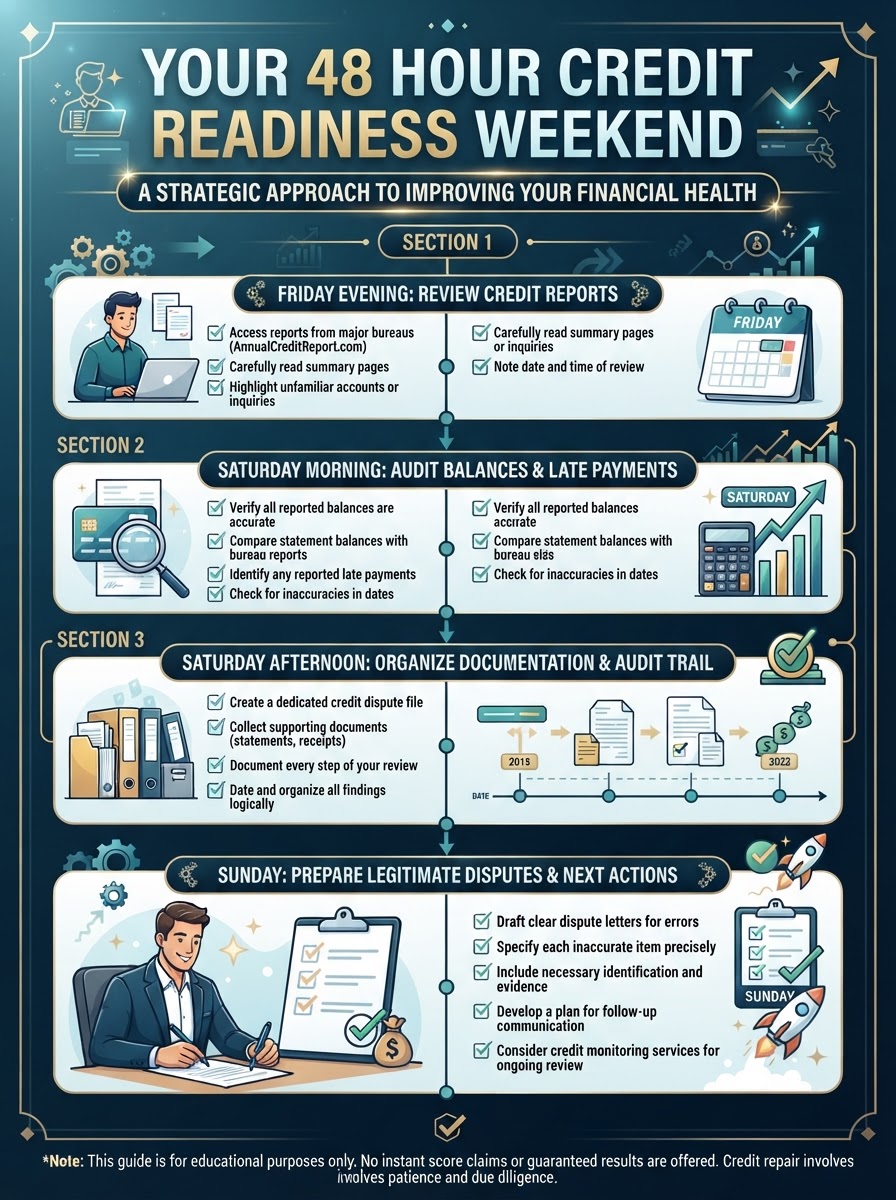
That is the idea behind the Weekend Readiness Score Booster Timeline. The name describes the credit-readiness actions you're completing. It does not mean your credit score is guaranteed to increase within 48 hours.
Weekend Readiness Score Booster Timeline
Complete a focused credit-readiness review over one weekend. Check each action as you complete it.
Friday Evening — Know What's Being Reported
Saturday Morning — Audit the Details
Saturday Afternoon — Build the Evidence File
Sunday — Choose the Correct Action
0 of 12 actions completed.
Start with the reports. You can't intelligently act on information you haven't reviewed.
VEOL Asset 4: WebP · 600×800 (2:3) · <100KB · File: 48-hour-weekend-credit-readiness-timeline.webp · Pinterest: "The Weekend Credit Checklist to Complete Before Your Next Application"
Why 48 Hours Can Still Matter Even When Your Score Doesn't Change in 48 Hours
This distinction is important. You're not promising yourself: "By Sunday night I'll have a higher score." Instead, you're saying: "By Sunday night I will know what is actually on my reports and what deserves action."
That's realistic. And valuable.
Because imagine applying for that apartment first... then discovering an inaccurate late payment. Or applying for financing... then noticing that a card is reporting a balance you weren't expecting. Or getting denied... then finally pulling the report you should have reviewed before applying.
You don't need fear for fear's sake. You need to understand the cost of avoidable surprise.
The CFPB specifically recommends reviewing credit reports for errors that could affect lending terms and notes that credit-report information can also affect some employment decisions.
Your application may be urgent. That doesn't mean your preparation should be rushed.
Credit Report Has Errors — What Do I Do?
If you believe information is inaccurate, use this simple sequence:
Step 1: Identify exactly what appears wrong.
Don't write: "This whole account is wrong." If that's not actually the issue. Be specific. Example: "The account reports a 30-day late payment for March 2026. My March statement and bank confirmation show the payment was received on March 12, before the due date."
Step 2: Gather supporting records.
Possible evidence includes: statements, bank records, payment confirmations, correspondence, account histories, identity-theft documentation when genuinely applicable, and the relevant section of the credit report.
Step 3: Dispute with the appropriate credit reporting company.
Explain what you believe is wrong. Explain why. Request the correction. Include copies—not irreplaceable originals—of supporting documentation.
Step 4: Consider disputing directly with the furnisher.
The CFPB recommends disputing inaccuracies with both the credit reporting company and the company that supplied the information.
Step 5: Keep your audit trail.
Save: the date, what you submitted, where you submitted it, supporting documents, confirmation numbers, responses, and updated reports.
This isn't glamorous. It isn't a viral "credit hack." But documentation is what turns: "I think that's wrong" into: "Here is exactly what I believe is wrong and here is why."
How Fast Can Credit Report Errors Be Corrected?
This is where you need to separate marketing promises from federal procedure. Credit reporting companies generally have 30 days to investigate a dispute. Certain circumstances can extend that period to 45 days. After an investigation is completed, the CFPB says the reporting company generally has five business days to notify you of the results.
So if someone promises: "We'll delete this by Monday" when it's Friday... they're promising a result they do not control.
What can you accomplish this weekend?
You can: review your reports, identify potential inaccuracies, calculate utilization, organize evidence, separate legitimate disputes from accurate negative information, prepare appropriate correspondence, create an audit trail, and develop your next-action list.
That's what credit readiness actually looks like.
| FCRA Stage | Statutory Timeline | Source |
|---|---|---|
| CRA investigation | 30 days (standard) | FCRA § 611(a)(1) |
| Extended investigation | 45 days (if additional info submitted) | FCRA § 611(a)(1) |
| Results notification | 5 business days after completion | CFPB guidance |
| Consumer prep (this weekend) | 48 hours (self-directed) | Educational framework |
Statutory timelines govern CRA investigation, not consumer preparation. The 48-hour weekend framework refers to organizing your own review, not guaranteed bureau action.
The Most Dangerous Credit Mistake When You're in a Hurry
It's not always having a low score. Sometimes it's becoming so desperate to change the score that you'll try anything.
That's when people buy questionable tradelines. File disputes they know aren't truthful. Fall for "new credit identity" schemes. Pay people who promise guaranteed deletions. Or spend hours copying random dispute letters from strangers online without understanding whether the letters apply to their situation.
The FTC's guidance is direct: credit-repair companies cannot legally remove accurate and current negative information, and consumers can perform legitimate dispute work themselves for little or no cost.
That's exactly why this website should never need to promise you magic. You don't need magic. You need a system.

VEOL Asset 5: WebP · 1200×675 (16:9) · <100KB · File: weekend-credit-readiness-system-guide.webp · Pinterest: "Stop Guessing About Your Credit: Organize It This Weekend"
If You Need Better Credit Soon, Don't Waste This Weekend Guessing
You've already done something most people postpone: You started looking for an answer. Now comes the decision. Take the information you just learned and put it into a process.
The Weekend Credit Readiness System — $17
Not because spending $17 changes your credit. It doesn't. You're buying organization. A process. A way to sit down this weekend and stop saying "I really need to figure out my credit" — and actually start figuring it out.
Get The Weekend Credit Readiness System — $17Digital product delivered immediately after purchase.
Frequently Asked Questions
How can I raise my credit score fast?
There is no legitimate method that guarantees a specific credit-score increase within a specific timeframe. Potentially useful steps include reviewing your credit reports for inaccuracies, disputing information you reasonably believe is inaccurate or incomplete, reviewing reported revolving balances, continuing to make required payments on time, and avoiding unnecessary new debt.
What are quick ways to boost a credit score?
"Quick" should mean actions you can begin quickly—not guaranteed score results. You can promptly review your reports, calculate utilization, identify possible reporting errors, gather dispute documentation, and evaluate whether paying down revolving balances makes financial sense. When or whether a particular score changes depends on reporting and scoring factors.
How do I dispute a late payment?
First determine why you believe the late payment is inaccurate or incomplete. Gather supporting records and dispute the specific issue with the credit reporting company and the company that furnished the information. The CFPB recommends clearly explaining what is wrong and providing copies of supporting documents.
Can I remove a late payment from my credit report?
If the reported late payment is inaccurate or incomplete, you have the right to dispute it. If it is accurate and current, federal law does not give you a general right to have it removed simply because it negatively affects your credit.
What is a goodwill adjustment?
A goodwill adjustment is a voluntary request to a creditor regarding accurately reported negative information. It is not an FCRA accuracy dispute and creditors are not required to grant it. Never falsely characterize accurate information as an error.
How long does a credit dispute take?
Credit reporting companies generally must investigate disputes within 30 days, although certain situations can extend the investigation period to 45 days.
Can a credit repair company guarantee that negative accounts will be deleted?
No legitimate marketer should guarantee the removal of accurate and current negative information. The FTC says credit-repair companies cannot legally remove accurate, current negative information merely because it is unfavorable.
What should I do if my credit report has errors?
Identify each specific error, gather supporting records, dispute the information with the credit reporting company and furnisher, save copies of everything, and track the investigation. Consumers have a federal right to dispute inaccurate or incomplete information without paying someone to do it.
Is 30% credit utilization the ideal number?
There is no universal utilization percentage that guarantees the best possible credit score. Lower revolving balances can be favorable in many scoring contexts, but the effect depends on the consumer's complete credit file and the scoring model.
Should I pay to become an authorized user on a stranger's credit card?
Be cautious. The FTC has challenged businesses promoting paid stranger tradelines or "credit piggybacking" alongside promises of major credit-score improvements. A genuine authorized-user relationship with someone you know is different from purchasing a stranger's tradeline.
Consumer Education Disclosure
This page provides general educational information and is not legal, lending, employment, housing, financial, tax, or individualized credit advice. Purchasing The Weekend Credit Readiness System does not guarantee: a credit-score increase, a particular credit score, deletion of accurate information, successful dispute results, approval for housing, loan or credit approval, employment, reduced interest rates, or any other specific financial outcome. Consumers have the right to dispute information they reasonably believe is inaccurate or incomplete without purchasing this product. Accurate current negative information generally cannot legally be removed merely because it has an unfavorable impact. Results depend on each consumer's individual circumstances, information furnishers, consumer reporting agencies, reporting cycles, and scoring models.